

thermionic valve
- noun
- /ˌθɜrˈmiːɒnɪk vælv/
- Archaic
- Early radios often used a thermionic valve to amplify weak signals.
Examples
-
Many musicians still prefer thermionic valves for their warm sound.
-
The engineer replaced the faulty thermionic valve to restore audio clarity.
-
With the arrival of transistors, the thermionic valve became largely obsolete in modern electronics.
-
The thermionic valve is essential for vintage radios.
-
Early radios often used a thermionic valve to amplify weak signals.
-
The engineer replaced the faulty thermionic valve to restore audio clarity.
-
With the arrival of transistors, the thermionic valve became largely obsolete in modern electronics.
Synonyms

 65
8.8
65
8.8

An old glass part used in radios and sound equipment to make sound louder
 5
5.3
5
5.3
A glass or metal tube with empty space inside that controls electricity
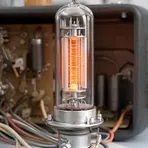
A glass or metal device that controls the flow of electricity in old radios and machines

A glass or metal tube that uses heat to make electricity flow without air

A glass or metal device that controls electric current in old radios and televisions
Surface Forms
Morphology
The phrase is a straightforward adjective+noun composition: 'thermionic' (electron emission from heated materials) modifies 'valve' (a flow-control device), so a learner who knows both parts can infer it is a device that controls electron flow via thermionic emission (i.e., a vacuum tube). Although technical, the meaning is directly derivable from the constituents and follows normal compositional patterns.
Etymology
The noun thermionic valve comes from two images: thermionic means heat makes metal give off tiny electric particles, and valve compares the part to a tap that opens or closes to control flow. So the name helps you remember it is an old electronic part that uses heat to control electric flow and to 'amplify' weak signals.