
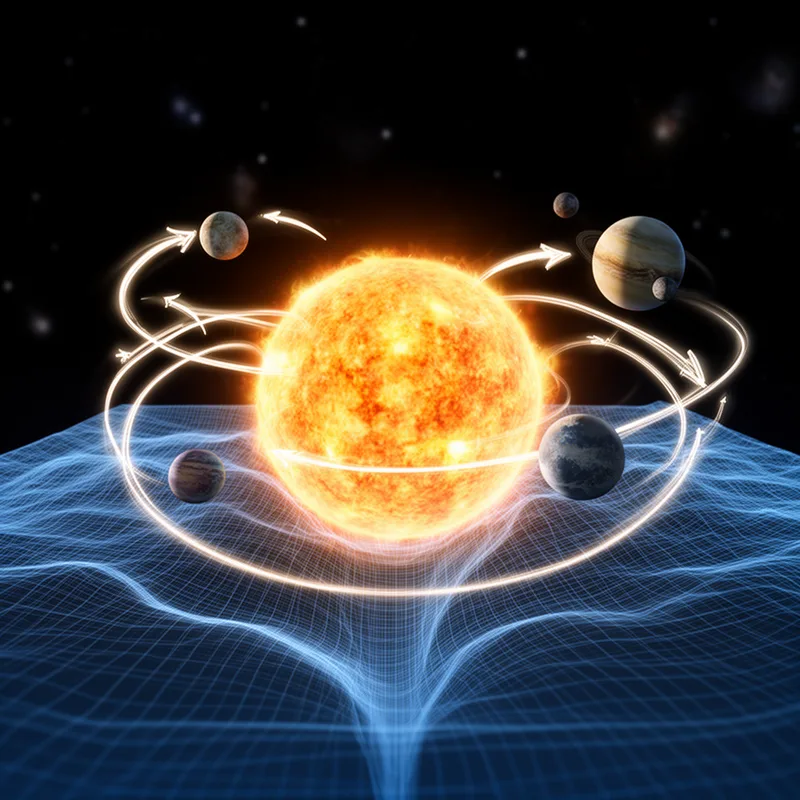
theory of gravitation
- noun
- /ˈθiəri əv ˌgrævɪˈteɪʃən/
- Specialized
- According to Newton's theory of gravitation, every object with mass exerts a gravitational pull on other objects.
- Newton's theory of gravitation
- Einstein's theory of gravitation
- published his theory of gravitation
Examples
-
The theory of gravitation describes how the distance between two objects affects the strength of their attractive force.
-
Moreover, Einstein's theory of gravitation breaks down at small distances.
Academic text (2004) -
Newton's theory of gravitation is a limiting case of GR in the weak field regime.
Blog text (3) -
The theories used for calculating the phase shift have been quantum mechanics and Newton's theory of gravitation (the Earth's gravitational field is a weak field).
Blog text (3) -
In searching for a new theory of gravitation, Dicke was influenced by the conjectures of Ernst Mach, a 19th-century physicist and positivist philosopher.
Academic text (1994) -
Einstein's theory of gravitation explains how massive bodies attract each other with a force proportional to their masses.
Synonyms

 4
3.7
4
3.7

An idea that all objects pull on each other, more when they are heavier and closer

 1
4.8
1
4.8
A scientific idea that objects with mass pull on each other more strongly when they are heavier and closer
A scientific theory saying any two objects pull each other more if heavier and less as they get farther apart

A law saying every two objects pull each other with force that grows with mass and decreases with distance

All objects attract each other with a force that grows with mass and falls with distance
Surface Forms
Morphology
theory + of + gravitation
The meaning is directly and transparently built from 'theory' (a set of ideas) + 'of' + 'gravitation' (the force causing masses to attract); a learner who knows the constituent words will interpret this as 'a theory about gravitation'. The English 'N of N' compositional pattern is cross-linguistically common and follows straightforward semantics, making the MWE immediately understandable.
Etymology
The phrase theory of gravitation comes from a simple image: one famous story says Isaac Newton saw an apple fall and pictured an invisible force pulling things toward each other. So, the theory of gravitation is the idea that bodies 'pull' or 'attract' one another, which explains why things fall and why planets move around the Sun.