

theory of gravity
 4
3.7
4
3.7

- noun
- /ˈθɪəri əv ˈɡrævɪti/
- Specialized
- Many scientific advancements are built on the principles established by the theory of gravity developed by Newton.
- metric theories of gravity
- Newton's theory of gravity
- quantum theory of gravity
Loading YouTube…
Watch on YouTubeSo this is the prediction that you get from Einstein's theory of gravity.
- So this is the prediction that you get from Einstein's theory of gravity.
- So you had Newton's theory of gravity, then Einstein's theory, you know, superseded it.
- But then in his theory of gravity, he suggested that gravity is just the curvature of space and time.
- The next question, if your Einstein is how are you going to use that technology to come up with a physical theory, a theory of gravity?
- But what was lacking in Einstein's formulation of special relativity was any version of a consistent theory of gravity.
- And so it is thought that the next big thing will be a quantum theory of gravity.
- So that's the discovery of string theory, the realization that it could serve as a quantum theory of gravity.
- And this means we simply don't have a theory of gravity for quantum particles, even though all matter is made of quantum particles.
- Well, if we have a quantum theory of gravity, I remind you, general relativity is a theory of space and time.
Examples
-
Einstein's theory of gravity explains how massive objects can warp the fabric of space and time.
-
Then, after a decade of intense work, Einstein produced his theory of gravity, the general theory of relativity.
Academic text (1991) -
Maybe we need a new theory of gravity to get us beyond this.
-
There used to be a theory called the "theory of gravity" too, which many people at the time didn't accept.
Blog text (5) -
This is what we get from solving Einstein's theory of gravity on a computer.
-
But then in his theory of gravity, he suggested that gravity is just the curvature of space and time.
-
So in Einstein's theory of gravity, mass bends light.
-
Now, for the first time, astronomers had the chance to use the eclipse to test the new theory of gravity.
Academic text (1991) -
Now our best theory of gravity is still Einstein's theory of general relativity, which says that that heavy objects, massive things curve space itself.
-
The modern era in cosmology began with Einstein's formulation of general relativity, his sweeping extension of Newton's theory of gravity.
Academic text (2006)
Synonyms

 1
4.8
1
4.8
A scientific idea that objects with mass pull on each other more strongly when they are heavier and closer
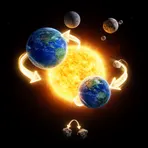
A scientific theory saying any two objects pull each other more if heavier and less as they get farther apart

A scientific idea about how objects pull each other, with larger objects pulling more and pull weakening with distance

All objects attract each other with a force that grows with mass and falls with distance

A law saying every two objects pull each other with force that grows with mass and decreases with distance
Surface Forms
Morphology
A B1 learner who knows 'theory' (an explanatory framework) and 'gravity' (the force causing objects to fall) can readily infer that 'theory of gravity' means the explanation about gravity. The 'theory of X' compositional pattern and the function word 'of' make this construction transparent and cross-linguistically predictable.
Etymology
The phrase theory of gravity comes from a simple picture: one famous story says a man named Isaac Newton watched an apple fall, helping people imagine a natural pull called gravity. So the theory part is the idea that explains why objects are pulled together, 'fall', or move around each other like the planets.