
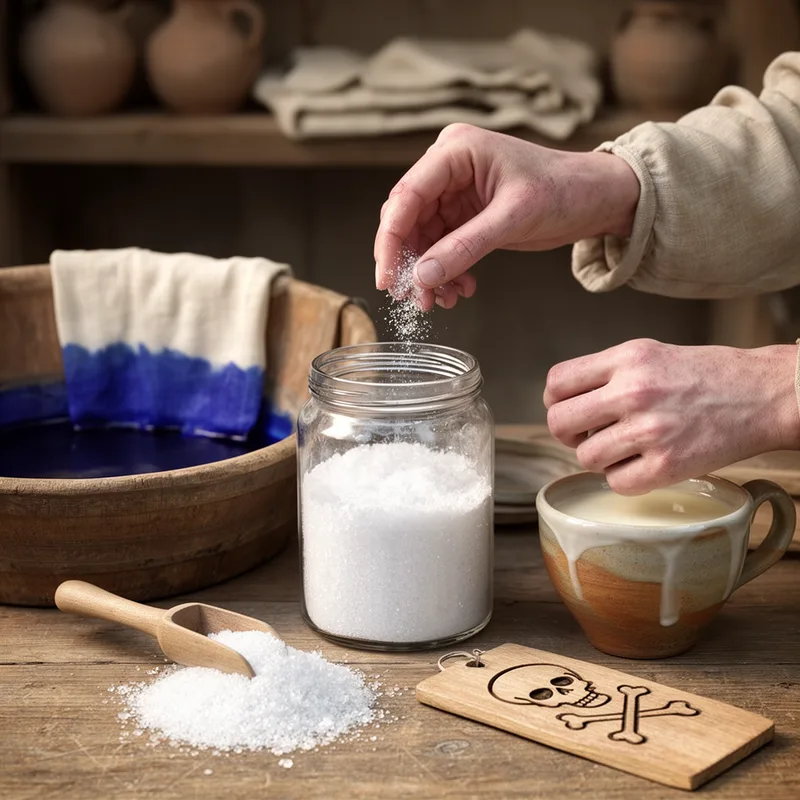
sugar of lead
- noun
- /ˈʃʊɡər əv lɛd/
- Archaic
- Historically, sugar of lead was used in cosmetics despite its toxicity.
Examples
-
Symptoms of poisoning developed after exposure to sugar of lead in the dye works.
-
The old recipe called for sugar of lead to improve the glaze on pottery.
-
The chemist analyzed sugar of lead for its toxic properties.
-
Have you ever heard of sugar of lead?
-
In the 19th century, 'sugar of lead' was used in some medicines despite its dangerous properties.
-
The artist created vibrant colors for his paintings by mixing pigments with 'sugar of lead'.
-
When researching historical dyeing methods, I discovered that 'sugar of lead' was commonly used for fabric coloration.
Synonyms

A poisonous white chemical used to dye cloth and make coatings for metal and wood
How Toxic


Surface Forms
Morphology
sugar + of + lead
Although the phrase combines the familiar words 'sugar' and 'lead', a B1 learner would not infer that it names lead acetate (a poisonous crystalline compound) rather than edible sugar; the compound sense and historical/chemical usage are non‑compositional and archaic. Because the meaning cannot be reliably derived from the constituents and is specialized/idiomatic, the expression is opaque to learners.
Etymology
Sugar of lead got its name because the white, crystal-like powder of lead tasted like sugar, so people called it 'sweet' even though it was 'poisonous'. That's why the term means a poisonous white compound once used to make shiny coatings on pottery, in dyeing and in old cosmetics.