

lead acetate
- noun
- /lɛd ˈæsəˌteɪt/
- Specialized
- For safety reasons, it is important to avoid exposure to lead acetate during dyeing processes.
Examples
-
When the rats are weaned (21 days of age in this lab), select the number of animals desired and treat their drinking water with lead nitrate or lead acetate (7.6 grams/gal.) for at least 90 days.
Academic text (1996) -
Oral exposure to lead acetate changed the arrangement and shape of and reduced the number of Sertoli cells.
Academic text (2015) -
Oral exposure to lead acetate changed the arrangement and shape of spermatogonial cells and reduced the number of Sertoli cells.
Academic text (2015) -
The artist used lead acetate in the varnish to achieve a brilliant finish on the canvas.
-
In industrial settings, lead acetate is often handled with caution due to its toxic properties.
Synonyms
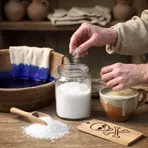
A poisonous white chemical used long ago to dye fabrics and make glazes
Surface Forms
Morphology
The phrase denotes a chemical salt composed of the element 'lead' and the 'acetate' ion; knowing 'lead' (the element) and 'acetate' (a salt/ester) allows a learner to infer it is a lead-containing chemical compound. This follows regular, compositional chemical naming conventions that are cross-linguistically transparent, so the overall meaning is directly derivable from the parts.
Etymology
The noun lead acetate comes from its two parts: lead, the heavy metal, and acetate, a name from 'vinegar'. In the past, people made it by mixing lead with vinegar, so the name helps you remember it is a white, poisonous chemical used in dyeing.

