
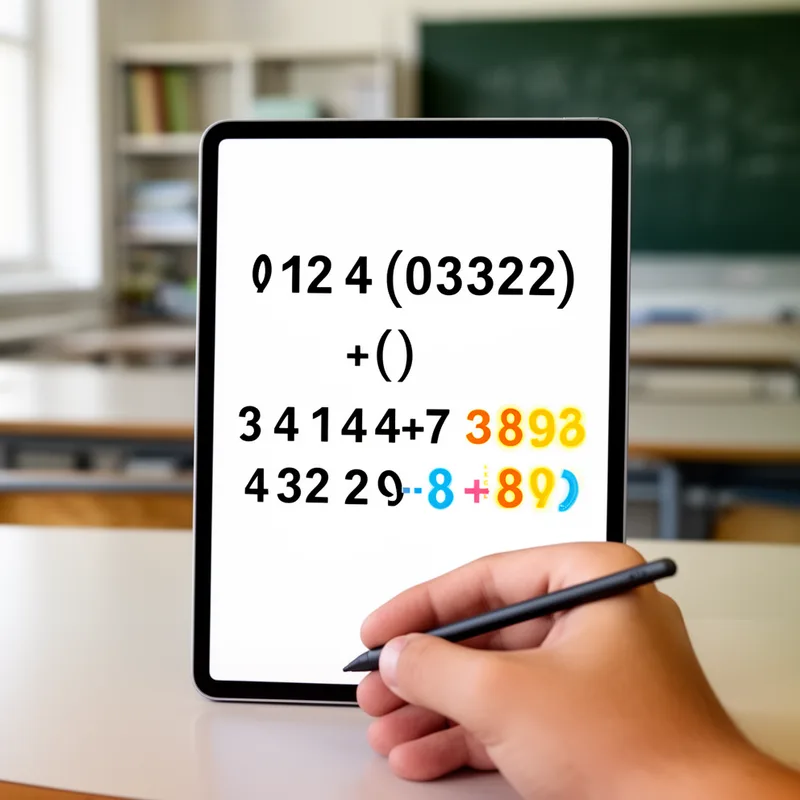
suffix notation
- noun
- /ˈsʌfɪks noʊˈteɪʃən/
- Specialized
- In suffix notation, the expression '3 4 +' means 3 plus 4.
Examples
-
Some calculators use suffix notation instead of the more common infix notation.
-
In suffix notation, the expression '3 4 +' represents the operation of adding 3 and 4.
-
Learning suffix notation can make it easier to design efficient parsers for calculators.
-
The expression is written in suffix notation.
-
Can you explain suffix notation to me?
-
Some programming languages prefer suffix notation for its simplicity and efficiency.
-
When using suffix notation, the computation proceeds from left to right, applying operators after their operands.
Synonyms
A way of writing math expressions without parentheses where each sign comes after the numbers

A way to write math with numbers before the sign so no parentheses
A way of writing math where operators come after numbers
Surface Forms
Morphology
The parts 'suffix' (something appended at the end) and 'notation' (a system of symbols) combine to give a plausible compositional sense: a way of writing where elements are placed after others. However, the precise mathematical interpretation (operators following operands and the parenthesis-eliminating consequence) is specialist knowledge and not fully predictable for an average B1 learner, so it is only partially transparent.
Etymology
Suffix notation is a way of writing math where the math sign comes after the numbers; the word suffix means 'after' and notation means 'a way of writing'. So '3 4 +' puts the plus sign after 3 and 4, and that clear order means you do not need parentheses.

