
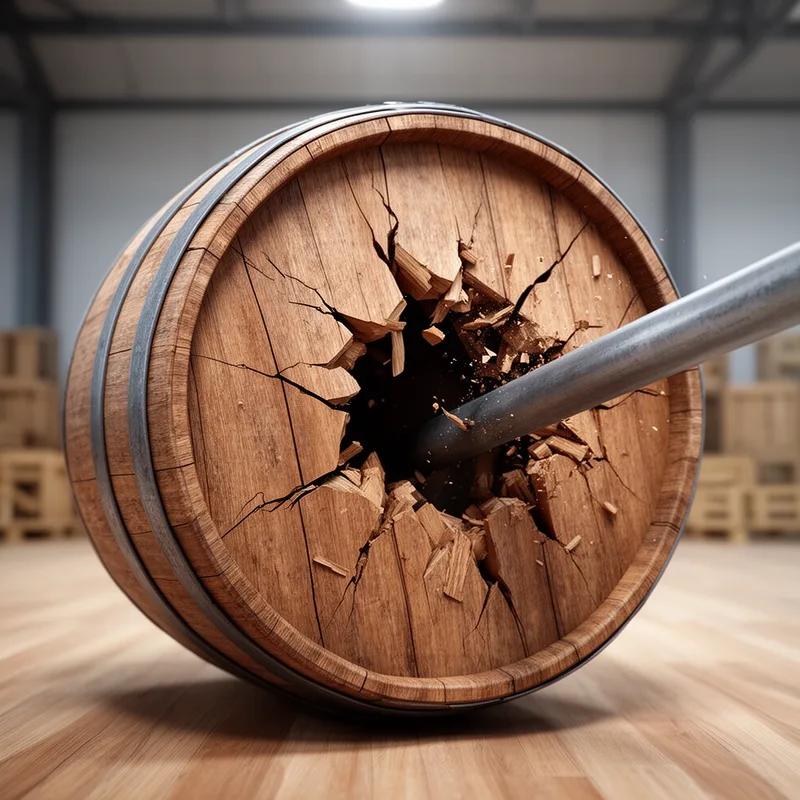
to stave in
- phrasal verb
- /steɪv ɪn/
- He used a hammer to stave in the rotten wood, creating a hole in the door.
- staved in my skull
- staved in with a rock
- head staved in
Examples
-
To prevent barrel fever, Washington ordered all casks staved in.
Academic text (1992) -
During the storm, several houses had their roofs staved in by falling debris.
-
The side had been staved in.
-
"Each with its head staved in."
Fiction book (1994) -
"Are you going to stave in my skull?" Despite himself, his neck muscles contracted, already preparing for the blow.
Fiction book (2002) -
But who was to make the connection between three passes with the crop duster and all these staved-in roofs?
Fiction book (1993) -
Its facade has staved in the surface a splintered timber and a scatter of plaster.
-
He was working on power shots: his left hooks made a perfect L from shoulder to glove, staving in the bag on one side; his straight rights imparted the illusion of animate sensitivity to the bag as it leapt away from the impact.
Academic text (2000) -
The car hit the tree, and the front was completely staved in.
Synonyms

 401
1.6
401
1.6

To press something hard so it breaks or loses its shape
 311
2.1
311
2.1
To break something into many pieces using great force
 38
4.1
38
4.1
Force a door or gate open by hitting it hard with your foot
 6
6.4
6
6.4
To make an opening in something by cutting or piercing
 6
8.5
6
8.5
To break a hole in an object by hitting or crushing it
 5
4.7
5
4.7
To damage something very badly so it breaks into pieces
 1
3.5
1
3.5
To force open a door or window to get inside
Antonyms


How Damaged

Surface Forms
Morphology
The meaning 'to break or smash a hole in something' is directly compositional from 'stave' (to break in or crush) plus the directional particle 'in' indicating inward force. This verb + particle pattern is a regular English construction and is cross-linguistically transparent, so a B1 learner who knows both constituents would readily infer the MWE's meaning.
Etymology
Stave in may come from barrels: the wooden boards of a barrel are called staves, and if you hit a barrel you can push those staves in, making it cave and break. That's why stave in now means 'to break or smash a hole in something'.