
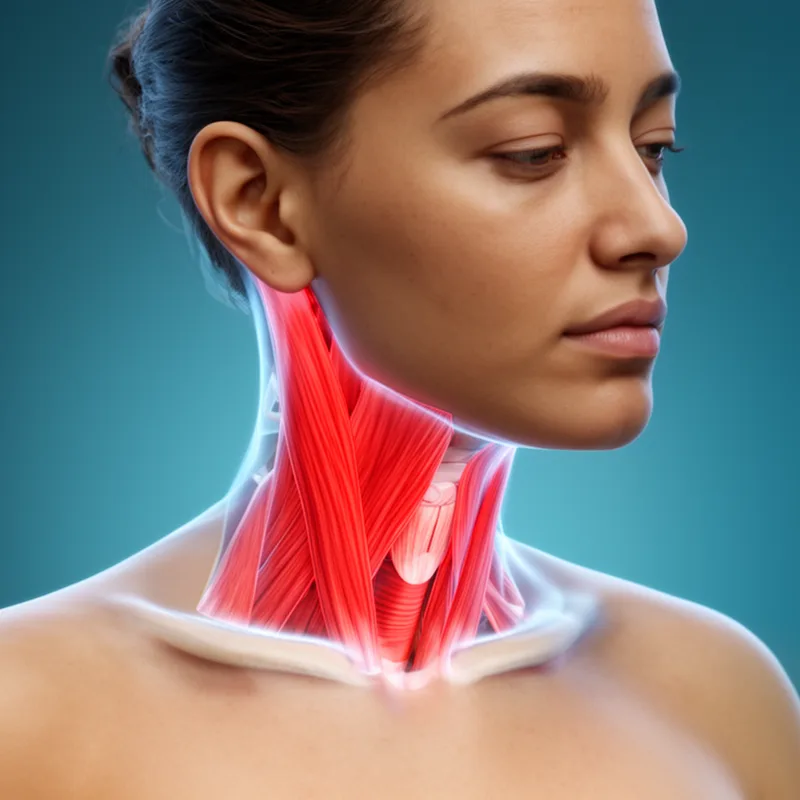
sternocleidomastoid muscle


 1
7.2
1
7.2
- noun
- /ˌstɜrnəˌklaɪdəˈmæsˌtɔɪd ˈmʌsəl/
- Specialized
- The doctor examined the sternocleidomastoid muscle to assess the patient's neck movements.
- anterior to the sternocleidomastoid muscle
- border of the sternocleidomastoid muscle
- affected sternocleidomastoid muscle
Examples
-
Congenital muscular torticollis is a result of excessive shortening of the sternocleidomastoid muscle, which leads to an imbalance of muscle function around the neck.
Academic text (2015) -
By having the infants play in a prone position with the neck extended, bilateral sternocleidomastoid muscle elongation was encouraged.
Academic text (2015) -
First, the location of a mass in the sternocleidomastoid muscle was considered influential to the rehabilitation outcome.
Academic text (2015) -
The new mass was found to have infiltrated the superior end of the sternocleidomastoid muscle.
Academic text (2008) -
Physical examination revealed a 4x5 cm freely mobile, firm mass below the level of the sternocleidomastoid muscle.
Academic text (1995) -
Demirbilek and Atayurt described passive and active stretching of the sternocleidomastoid muscle on the affected side and used firm pressure in both techniques.
Academic text (2015) -
In side-lying position, we prolonged lengthening of the affected sternocleidomastoid muscle without the stress of passive stretching.
Academic text (2015) -
At 7 months postoperatively, a recurrent mass posterolateral to the sternocleidomastoid muscle was detected.
Academic text (2008) -
The patient reported fullness in the area of the left sternocleidomastoid muscle and a soft, tender swelling in the left postauricular area.
Academic text (2006) -
Examination revealed a firm 2.5-cm mass over the posterosuperior border of the right sternocleidomastoid muscle, inferior to the mastoid process.
Academic text (2001)
Synonyms
 1
9.9
1
9.9
A thick neck muscle on each side that turns and bends the head

A thick neck muscle on each side that turns the head the other way and helps bend the neck
Surface Forms
Morphology
The phrase is fully compositional: it names a specific muscle ('sternocleidomastoid') and appends the general noun 'muscle', so a learner who knows both constituents can infer it refers to that neck muscle. Although 'sternocleidomastoid' is a technical complex form, its meaning as a particular muscle is explicit, and the construction follows normal noun + noun naming patterns for body parts.
Etymology
Sternocleidomastoid muscle gets its name from three parts: sterno meaning chest, cleido meaning collarbone, and mastoid meaning the bony lump behind the ear. The name shows the muscle goes from the chest and collarbone up to that lump, so it 'turns the head' and 'bends the neck'.