

sternocleidomastoid
 1
9.9
1
9.9

- noun
- /ˌstɜrnəˌklaɪdəˈmæstɔɪd/
- Specialized
- The sternocleidomastoid muscle plays a crucial role in head rotation and flexion.
- sternocleidomastoid muscle
- thickness of the sternocleidomastoid
- sternocleidomastoid tumor
Examples
-
TI-weighted MRI confirms the presence of the left cervical mass at level II, anterior to the sternocleidomastoid muscle.
Academic text (2006) -
By having the infants play in a prone position with the neck extended, bilateral sternocleidomastoid muscle elongation was encouraged.
Academic text (2015) -
A separate mass was felt to the left of the sternocleidomastoid.
Academic text (2007) -
In the last case, his first stroke cut... the sternocleidomastoid muscle clean through.
-
First, the location of a mass in the sternocleidomastoid muscle was considered influential to the rehabilitation outcome.
Academic text (2015) -
The new mass was found to have infiltrated the superior end of the sternocleidomastoid muscle.
Academic text (2008) -
Re-exploration of the left neck mass demonstrated a cystic structure lying deep to the sternocleidomastoid.
Academic text (2007) -
Physical examination revealed a 4x5 cm freely mobile, firm mass below the level of the sternocleidomastoid muscle.
Academic text (1995) -
At 7 months postoperatively, a recurrent mass posterolateral to the sternocleidomastoid muscle was detected.
Academic text (2008) -
On examination, a 3 x 5-cm cystic mass was felt anterior to the sternocleidomastoid muscle.
Academic text (2010)
Synonyms


 1
7.2
1
7.2
A thick muscle on each side of the neck that helps you turn and bend your head
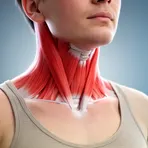
A thick neck muscle on each side that turns the head the other way and helps bend the neck
Compounds
- Specialized
1
7.2
A thick muscle on each side of the neck that helps you turn and bend your head

- Specialized
A vein that carries blood from the sternocleidomastoid neck muscle into the internal jugular vein
Surface Forms
Morphology
Etymology
The word sternocleidomastoid is made of three parts: sterno from 'chest', cleido from clavicle meaning 'collarbone', and mastoid meaning 'breast-shaped' for the bone behind the ear. So the name points to the long neck muscle that runs from the chest and collarbone to that bone and helps turn and bend the head.