
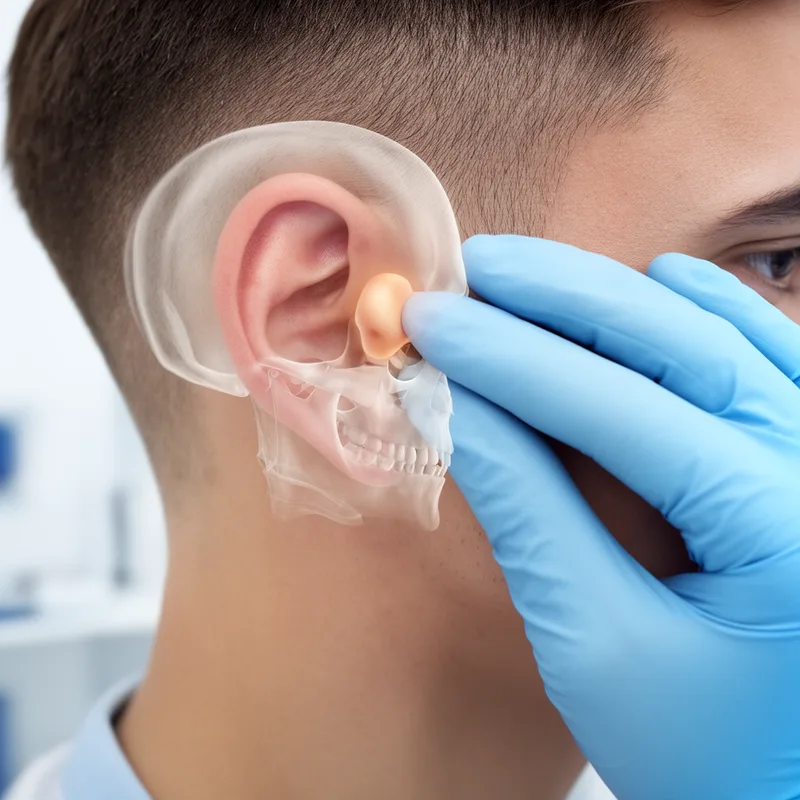
mastoid
 1
8.9
1
8.9

- noun
- /ˈmæstɔɪd/
- Specialized
- The surgeon explained that the mastoid is located just behind the ear and is crucial for hearing.
- ear and mastoid
- middle ear and mastoid
- left mastoid
Examples
-
Okay, he struck the mastoid, which is nearly 44 millimeters thick.
-
The patient underwent bilateral mastoid explorations, which revealed extensive granulation in the mastoid and middle ear segments.
Academic text (2009) -
Of these sites, the middle ear and mastoid appear to be the most common.
Academic text (2006) -
X-ray of the mastoid showed areas of rarefaction on the right side.
Academic text (2007) -
Patients with rhabdomyosarcoma of the middle ear and mastoid have a particularly poor prognosis.
Academic text (2005) -
We report a case of rhabdomyosarcoma of the middle ear and mastoid in a 3-year-old boy.
Academic text (2005) -
Clinical examination revealed further enlargement of the left mastoid and mandible.
Academic text (2008) -
Drilling superficial lesions of the mastoid and squama is a simple procedure.
Academic text (2008) -
The lesion had eroded the lateral wall of the mastoid and epitympanum and extended intracranially.
Academic text (2006) -
Residual cholesteatoma was found in the mastoid, the facial recess, and the anterior epitympanum.
Academic text (1996)
Synonyms

 1
6.1
1
6.1
A bony bump behind the ear at the base of the skull

A bony bump behind the ear at the base of the skull
Compounds
Surface Forms
Morphology
mastoid = mast + oid
Formed from the combining form 'mast-' (meaning 'breast') + suffix '-oid'; the combining form is not a standalone English word and the anatomical meaning is technical, so learners cannot derive the sense from common English 'mast'.
Etymology
Mastoid for the bone behind the ear comes from masto- 'breast' plus -oid 'like'. This name points to the bone's small, rounded bump behind the ear, so the mastoid bone is remembered by its 'breast-like' shape.