

mastoid
 2
8.9
2
8.9

- adjective
- /ˈmæstɔɪd/
- Specialized
- We present a rare case of a 25-year-old woman with a mastoid osteoma enlarging over a 6-month period.
- mastoid cavity
- mastoid osteoma
- mastoid segment
Examples
-
The doctor monitored the patient's recovery after mastoid surgery to ensure proper healing.
-
The surgeon explained that a problem with the mastoid area could lead to hearing loss.
-
However, Morocco reported a case of multiple osteomas of the mastoid process that were growing from the inner table.
Academic text (2008) -
Complete eradication of all diseased mastoid air cells is, of course, also essential.
Academic text (2001) -
An incision was made from the mastoid tip across the midline.
Academic text (2008) -
Adult anatomy will occur in this region as the mastoid tip develops postnatally.
Academic text (2003) -
Type 2: A fracture line travels across the mastoid process and extends to the external auditory canal.
Academic text (1998) -
In healthy humans, the mastoid area, the middle ear cleft, and the eustachian tube are sterile.
Academic text (2005) -
Osteomas are bony tumors that rarely involve the mastoid portion of the temporal bone.
Academic text (2008) -
Radiologists often study the mastoid anatomy to better understand ear-related conditions.
Synonyms

Relating to the bone behind the ear that looks like a small bump
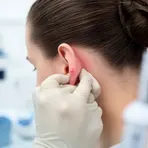
Located behind the outer part of the ear
Compounds
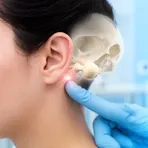



Surface Forms
Morphology
mastoid = mast + oid
Formed from the combining form 'mast-' (meaning 'breast') + suffix '-oid'; the combining form is not a standalone English word and the anatomical meaning is technical, so learners cannot derive the sense from common English 'mast'.
Etymology
Mastoid comes from the Greek root masto- meaning 'breast' and the ending -oid meaning 'like'. So mastoid literally means 'breast-shaped', which helps you remember it describes something with the rounded shape behind the ear.