
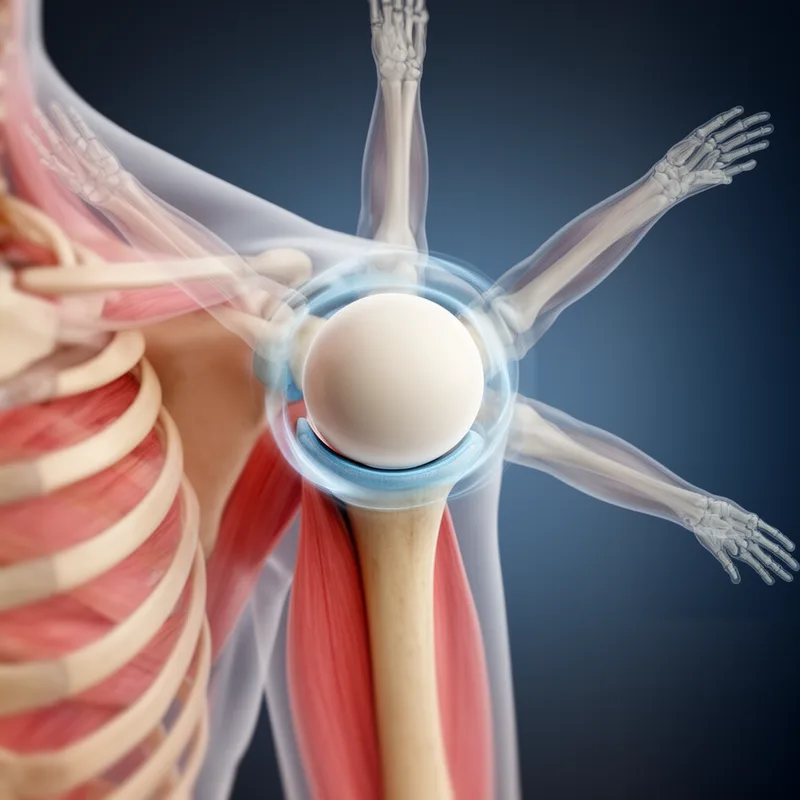
spheroid joint
- noun
- /ˈsfɪrɔɪd dʒɔɪnt/
- Specialized
- The shoulder is a classic example of a spheroid joint in the human body.
Examples
-
The spheroid joint in the shoulder allows for a wide range of motion.
-
Surgeons studied the movement of the spheroid joint to improve prosthetic designs.
-
Damage to the hip's spheroid joint can cause significant loss of mobility.
-
Many athletes rely on their spheroid joints for optimal performance.
-
The shoulder is a classic example of a spheroid joint that allows for a full range of motion.
-
Surgeons carefully examined the spheroid joint in the hip to enhance surgical techniques.
-
Damage to the spheroid joint can lead to severe limitations in an individual's mobility.
Synonyms


 1
4.1
1
4.1
A joint where a round bone end fits into a cup, allowing movement in many directions
A joint where a round bone head fits into a cup-like socket to move in many directions

A joint where a rounded bone fits into a cup-shaped socket to move in many directions like the hip

A joint where a rounded bone end fits into a cup in another bone, like the hip or shoulder
A joint where a rounded bone end fits into a cup socket to allow movement in many directions
How Mobile

Surface Forms
Morphology
The noun is transparently compositional: 'spheroid' (sphere-like) describes the shape of the anatomical 'joint', so the overall meaning of a joint with a spherical end fitting into a rounded cavity is directly derivable from the parts. This follows standard noun+noun compound logic and is cross-linguistically similar to 'ball-and-socket' constructions, so a B1 learner who knows both words should understand it.
Etymology
Spheroid joint comes from spheroid meaning 'ball-shaped' and joint meaning where bones meet; a round, ball-like end of one bone fits into a cup in another bone, like a 'ball in a socket', so it lets the body 'move in all directions'.