
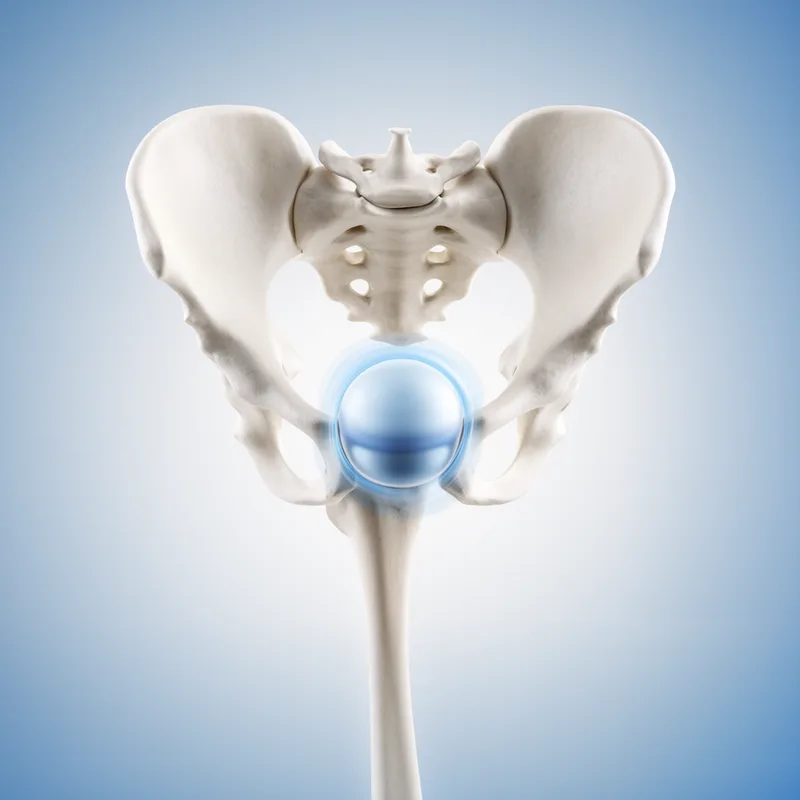
enarthrodial joint
- noun
- /ˌɛnɑrˈθrɒdɪəl dʒɔɪnt/
- Specialized
- The shoulder is an example of an enarthrodial joint, allowing for a wide range of movement.
Examples
-
The hip is classified as an enarthrodial joint because it permits motion in multiple axes.
-
Damage to an enarthrodial joint may result in limited flexibility and pain.
-
The enarthrodial joint allows for a wide range of motion.
-
Many athletes rely on their enarthrodial joints for performance.
-
The hip is classified as an enarthrodial joint because it permits motion in multiple axes.
-
The shoulder is an example of an enarthrodial joint, allowing for a wide range of movement.
-
Damage to an enarthrodial joint may result in limited flexibility and pain.
Synonyms


 1
4.1
1
4.1
A joint where a round bone end fits into a cup, allowing movement in many directions

A joint where a rounded bone fits into a cup-shaped socket to move in many directions like the hip
A joint where a rounded bone end fits into a cup socket to allow movement in many directions
A joint where a round bone head fits into a cup-like socket to move in many directions

A joint where a round bone end fits in a cup, letting movement in all directions
Surface Forms
Morphology
enarthrodial + joint
This is a technical anatomical term where the modifier 'enarthrodial' is not a transparent English word and derives from specialised Greek morphology unfamiliar to B1 learners. Knowing the general word 'joint' only signals a point of articulation; the specific sense ('rounded head fitting into a cup-like cavity allowing multiaxial movement') cannot be deduced without domain-specific knowledge, so the expression is not compositional for typical learners.
Etymology
Enarthrodial joint comes from Greek words that paint a simple picture: a rounded head that fits into a cup like one bone sitting in another bone's socket. So, the name explains why this joint 'can move in many directions'.