

to slack off
 3
3.9
3
3.9

- phrasal verb
- /slæk ɔf/
- Informal
- They say that one of the things that makes Weight Watchers effective is the regular weigh-ins; it's harder to slack off when you know somebody's going to be checking.
Loading YouTube…
Watch on YouTubeAnd if they slack off, they're probably going to go back down, right.
- And if they slack off, they're probably going to go back down, right.
- However, I had slacked off at the final leg of revision due to extreme burnout.
Examples
-
This year I am committed to doing hard things... and not slack off.
Blog text (34) -
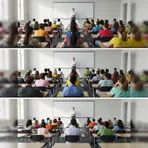
During the winter months, many students tend to slack off and not complete their assignments.
-
Then, parents sort of slack off and put the focus back on their own lives.
Blog text (32) -
I am in real estate, so I worked really hard for about 2 years before being able to slack off for a bit.
Blog text (34) -
And the fundamental research kind of slacked off and the companies went after scale up.
-
We get real busy with the early bird specials at four, but then around eight it starts to slack off.
Fiction book (1999) -
Laziness causes people to cut corners, to slack off, to waste time, and to contribute less.
-
I used to do daily readings of recovery literature, but I've slacked off over the years.
Blog text (32) -
Dr. Bettmann knows moments of despondency, his colleagues told us, usually when business has slacked off.
Fiction book (1999) -
After a busy first half of the year, sales began to slack off as summer approached.
Synonyms
 54
3.8
54
3.8
To become less strong, especially for bad weather, pain, or pressure
 49
2.6
49
2.6
Become less in number, amount, or quality
 48
6.4
48
6.4
To become less in size, amount, or strength
 23
6.8
23
6.8
To become less strong or severe and to make something do the same
 21
3.5
21
3.5
To become less in number or amount
 19
4.3
19
4.3
To become less in amount or quality
 9
4.0
9
4.0
To become gradually less strong or severe
 8
4.2
8
4.2
To become quieter and then stop
 3
5.3
3
5.3
To reduce effort, speed or attention
 2
3.3
2
3.3
To become less over time
 1
4.9
1
4.9
Become or make slower, for example the wind


 1
5.7
1
5.7
Move, act, or work less quickly and with less energy

To become less strong or active
Antonyms

How Intense
57
3.7

- Informal
3
3.9
47
4.8
- Informal
8
5.3
47
3.7
Surface Forms
Morphology
The verb 'slack' means to let up or reduce effort and the particle 'off' adds a sense of moving away from full activity or intensity, so the combined meaning 'to decrease effort or activity' is directly derivable from the parts. This verb+particle composition is a common, predictable pattern in English, so a B1 learner who knows both constituents would readily infer the meaning.
Etymology
Slack off comes from the picture of a tight rope or line becoming loose: when the rope goes slack and the pull is taken off, it stops pulling and things slow down. That's why slack off means 'to become less strong or active'.