

sidereal
 1
9.9
1
9.9

- adjective
- /saɪˈdɪəriəl/
- Specialized
- To track celestial objects accurately, astronomers often use sidereal time instead of solar time.
- sidereal time
- sidereal day
Loading YouTube…
Watch on YouTubeOne full revolution, OK, OK, That's called a sidereal day.
- One full revolution, OK, OK, That's called a sidereal day.
Examples
-
From 1846 to 1848, he published the Sidereal Messenger, the nation's first astronomical journal.
Academic text (2005) -
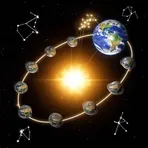
The seasonal or tropical year is actually a hair less time than one full orbit (sidereal year).
Blog text (13) -
But there is also the sidereal day.
Academic text (2007) -
But there is also a duration known as the sidereal day.
Academic text (2007) -
If you think about the physical situation, you will realize that the sidereal day must be shorter than the solar day.
Academic text (2007) -
At that moment, my local sidereal time would match the right ascension of that star.
Academic text (2002) -
Because Earth is simultaneously orbiting the Sun, the sidereal day is shorter than the solar day.
Academic text (2007) -
Esclangon equipped the buildings with the first sets of dual clocks providing the mean and sidereal times.
Academic text (2005) -
The actual period is estimated to be 365.256366 days, though at that point, tropical vs. sidereal year makes a noticeable difference.
Blog text (26) -
Following through with the experiment, now that I had a clock synchronized to GMT, I could calculate the sidereal time at Greenwich.
Academic text (2002)
Synonyms

Relating to star groups called constellations
Antonyms


Compounds


- Specialized
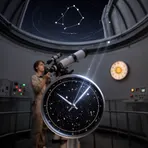
A time unit astronomers use to divide a day measured by the stars into 24 parts
- Specialized
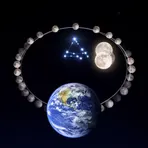
It takes about 27 days for the Moon to return to the same place among the stars
Surface Forms
Morphology
sidereal = sider + al
Although the word contains the familiar adjective suffix -al, the base stem is a learned classical form meaning 'star' that is not a recognizable English word for most learners.
Etymology
Sidereal comes from the Latin word sidus, which means 'star', so it literally means 'of the stars' and explains why sidereal time and the sidereal year are measured by the stars.