
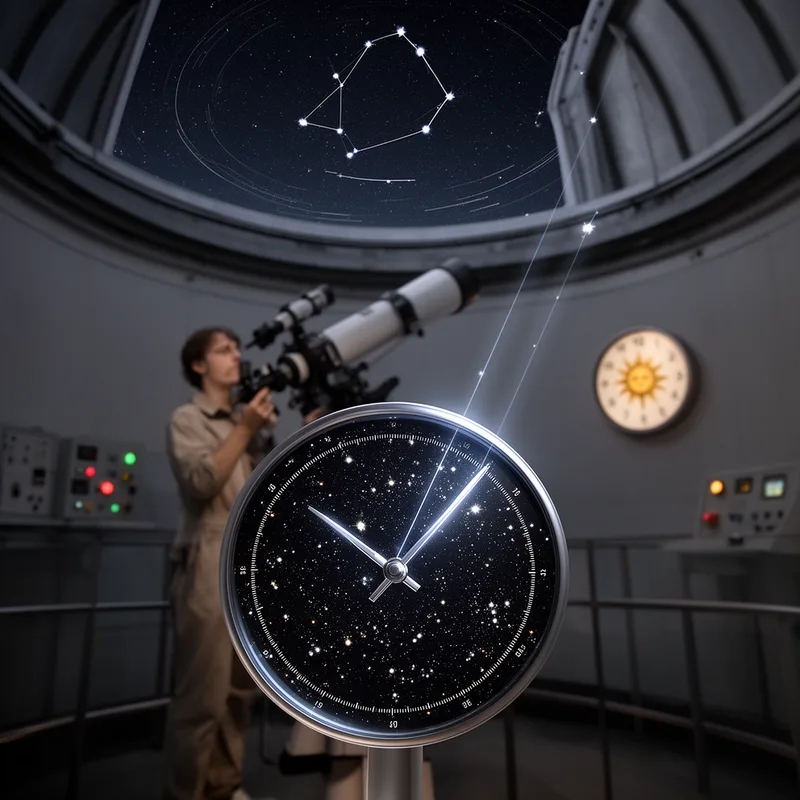
sidereal time
- noun
- /saɪˈdɪəriəl taɪm/
- Specialized
- Astronomers use sidereal time to accurately track the positions of stars in the night sky.
Examples
-
At that moment, my local sidereal time would match the right ascension of that star.
Academic text (2002) -
Following through with the experiment, now that I had a clock synchronized to GMT, I could calculate the sidereal time at Greenwich.
Academic text (2002) -
To align the telescope, he had to convert the standard time to sidereal time.
-
Understanding sidereal time is essential for observing celestial events accurately.
Synonyms

The time that shows the Earth's rotation relative to the stars
Surface Forms
Morphology
The noun phrase is compositionally built from 'sidereal' (relating to the stars) + 'time', so a learner who knows both constituents can infer it means 'time measured by/according to the stars'. The precise astronomical distinction from solar time is technical, but the core meaning is transparently derived from the parts and follows a common modifier+noun pattern.
Etymology
The term sidereal time comes from the simple idea of using the stars as a clock. Astronomers watch a star and note when it comes back to the same place, so sidereal time measures how the Earth turns compared with the 'stars' rather than the 'sun'.

