
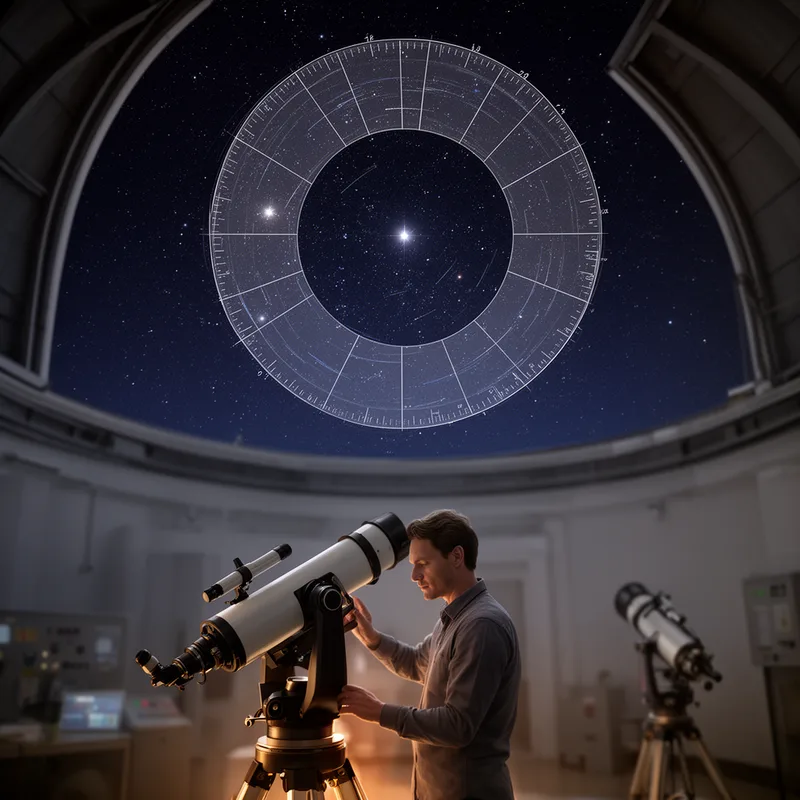
sidereal hour
- noun
- /saɪˈdɪəriəl aʊər/
- Specialized
- Unlike a solar hour, a sidereal hour is slightly shorter since the sidereal day is about four minutes less than a solar day.
Examples
-
The telescope's position was adjusted every sidereal hour to track the star.
-
One sidereal hour is approximately 59 minutes and 50 seconds.
-
In astronomy, a sidereal hour is used to divide the sidereal day into equal parts.
-
A sidereal hour is based on the Earth's rotation relative to distant stars.
-
In astronomy, a sidereal hour is used to divide the sidereal day into equal parts.
-
One sidereal hour is approximately equivalent to 59 minutes and 50 seconds.
-
At the observatory, scientists use a sidereal hour to measure the rotation of the Earth against the backdrop of distant stars.
Surface Forms
Morphology
The compound is compositionally transparent: 'sidereal' (relating to the stars) simply modifies 'hour', so a learner who knows both words can infer it is an hour used or measured in astronomy. Although the exact technical length (≈59m50s) is specialized knowledge, the basic meaning is directly derivable from the constituents and follows a common modifier+noun pattern.
Etymology
Sidereal hour comes from counting time by the 'stars' instead of the 'sun'. Because a day measured by the 'stars' is about four minutes shorter than a day measured by the 'sun', a sidereal hour is slightly shorter than a normal hour, so astronomers use it to track stars.

