

to separate from
 219
2.7
219
2.7

- phrasal verb
- /ˈsɛpəˌreɪt frʌm/
- Will wants to keep his music career separate from his movie career.
- separate from others
- separate from the rest
- separate and distinct from
Loading YouTube…
Watch on YouTubeSecond day he separates the sky from the sea.
- Second day he separates the sky from the sea.
- But how do we separate from people in a healthy way?
- And yet at some point we separated from that psychologically.
- The hand that was separated from his wrist thumped to the ground.
- But in the moments of execution, separate from the outcome and execute.
- It's like he's separating the man from the professional.
- The job is separating truth from untruth.
- When poker players win, they must separate luck from process.
Examples
-
Why is it that we continue to separate science from ethics?
-
Middle school students are working to define themselves as separate from peers and adults.
Academic text (2011) -
I believe you can separate art from an artist.
-
How are you going to separate yourself from the others in the market?
-
And then we separate our wet trash from our dry trash.
-
In her professional writing, she was careful to separate empirical fact from her own speculations.
Academic text (1990) -
In examining the principles, it is important to separate organizational issues from those of representation.
Academic text (1990) -
Both school campuses are surrounded by middle-class homes and are separated from commercial areas.
Academic text (2011) -
Netta disappeared behind the curtain that separated her bedroom from the rest of the cabin.
Fiction book (1993) -
The chef decided to separate from the traditional recipes and create his own style.
Synonyms
 256
4.2
256
4.2
To keep someone or something apart from others
 41
3.2
41
3.2
To stop people or objects from touching and mixing
 22
6.8
22
6.8
To separate things or parts for a special purpose
 12
4.3
12
4.3
To separate a part from a larger group for a special task
 7
3.7
7
3.7
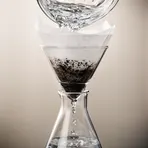
Remove one part from a mixture using a filter or another method
 2
3.9
2
3.9
To keep something separate for a special use or to show it as different
 2
7.0
2
7.0
To treat two things as separate and not related
 2
7.3
2
7.3
Treat two things as separate even if they are linked
 1
7.4
1
7.4
Separate things that are attached to each other


 1
7.0
1
7.0
To separate parts so they are no longer connected

To separate things or people from each other
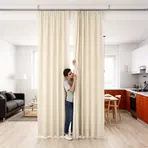
To divide a space with a wall or curtain to make a new area

To divide something into separate parts
Antonyms



How Separate

Surface Forms
Morphology
The meaning 'to keep apart or distinct' is directly and transparently built from 'separate' (to move apart or end an association) combined with the preposition 'from' (indicating exclusion or distance). This verb + preposition composition follows a standard, cross-linguistically common pattern, so a B1 learner who knows both constituents should be able to infer the MWE's meaning.
Etymology
Separate from paints a clear image: imagine pulling two objects apart or putting a small fence between them — the verb separate shows the moving away and from shows what it is kept away from, so it means 'to keep apart' or 'not mix'.