
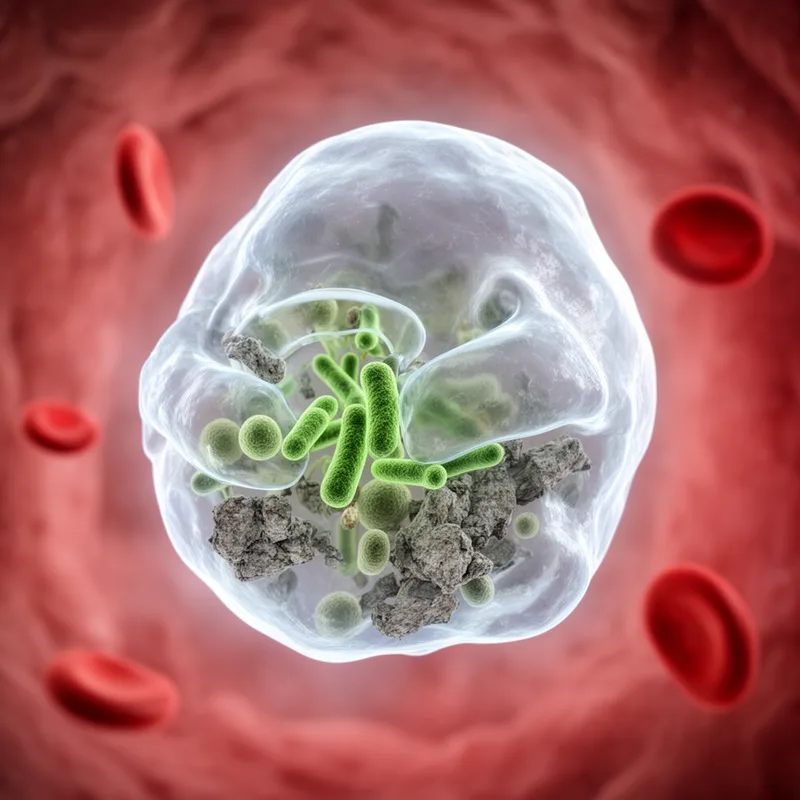
scavenger cell


 1
5.8
1
5.8
- noun
- /ˈskævɪndʒər sɛl/
- Specialized
- Research shows that scavenger cells play a vital role in cleaning up dead cells and other waste in tissues.
Examples
-
And there is the physiological tampering they do on us, the scavenger cells, biological nanomachines mucking about inside us trying to haul the calcium back where it belongs, and so forth.
Fiction book (1998) -
The scavenger cell engulfs and digests cellular debris to help maintain a healthy immune system.
-
When the body detects an infection, the scavenger cells respond by moving to the site to digest harmful bacteria.
Synonyms
 7
6.7
7
6.7
A large white blood cell that eats and removes germs and dead cells
 1
8.1
1
8.1
A cell that eats and destroys bacteria and dead cells to help the body's immune system
Surface Forms
Morphology
The meaning is directly derivable from the parts: 'scavenger' denotes an organism that eats dead/decaying matter and 'cell' denotes a microscopic living unit, so a 'scavenger cell' reasonably denotes a cell that engulfs or removes debris. Although biomedical, this is a straightforward metaphorical extension of 'scavenger' and follows common composition patterns, so a B1 learner who knows both words can infer the sense.
Etymology
The noun scavenger cell comes from scavenger, animals like vultures that eat dead things, and cell, a tiny part of the body. These cells 'scavenge' the body by surrounding and breaking down dead cells and germs, so they help 'clean up' during infection.