
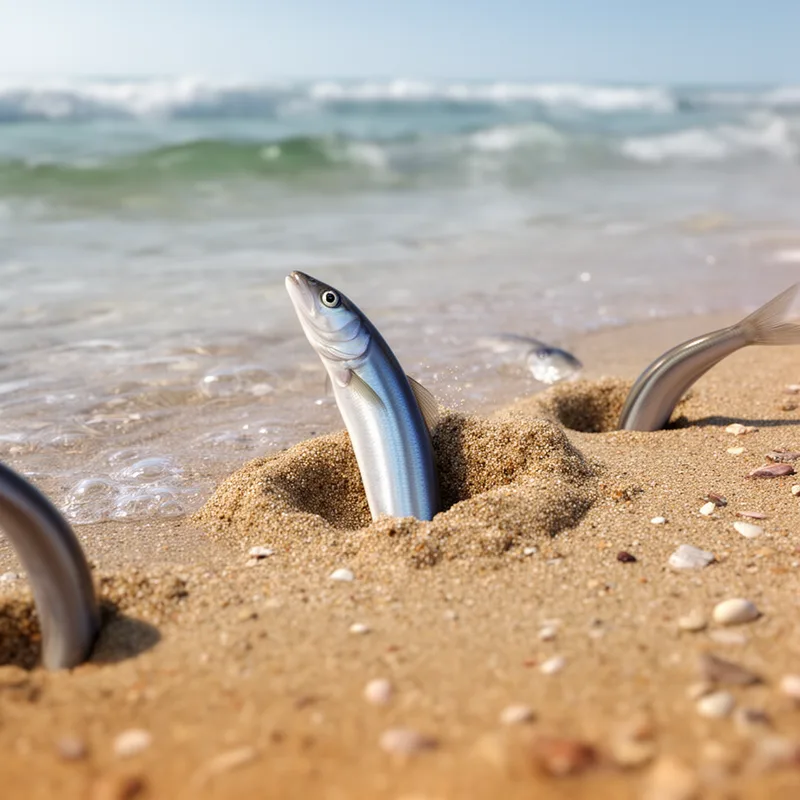
sand eel


 1
6.1
1
6.1
- noun
- /sænd iːl/
- In coastal habitats, sand eels often burrow into the sand for protection from predators.
Examples
-
Many birds search for sand eels in the shallow waters during low tide.
-
Fishermen caught a bucketful of sand eels to use as bait for larger fish.
-
Seabirds rely on sand eels as a primary source of food during breeding season.
-
The marine biologist observed sand eels burrowing quickly into the wet sand after the tide receded.
-
I caught a sand eel at the beach yesterday.
-
The fisherman showed us a sand eel he had caught.
-
The fisherman caught several sand eels while fishing near the shore.
Synonyms
 1
9.9
1
9.9
A very small silver fish like an eel that buries itself in sand near the shore

Very small thin silver fish that burrows into sandy beaches and forms schools

A small silvery fish that swims in schools and burrows into sand

A small fish that lives in sandy areas and burrows into the sand
How Big

Surface Forms
Morphology
The noun is a straightforward compound of 'sand' + 'eel' denoting an eel associated with sandy habitats, so a learner who knows both words can infer it refers to a small eel that lives in or near sand. This compositional, descriptive pattern is common cross-linguistically and follows normal English noun-modifier structure, making the meaning immediately derivable for a B1 learner.
Etymology
Sand eel gets its name from a simple picture: this small fish is long like an eel and lives in the sand, often burying itself to hide. So the name explains that it looks like an eel and spends much of its life in sandy places.