
salinization


 1
7.4
1
7.4
- noun
- /ˌsælɪnɪˈzeɪʃən/
- Specialized
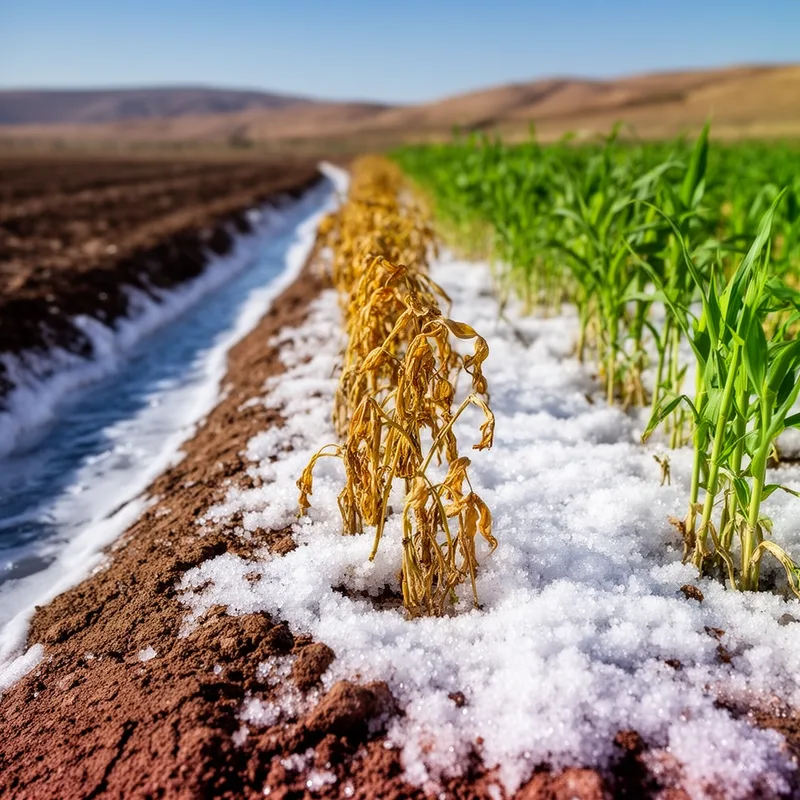
- In addition to contributing to groundwater depletion, irrigation results in salinization of the soil.
- salinization of soil
- salinization of land
- salinization of water
Examples
-
Salinization of the irrigated lands as a result of rising groundwater levels complements this process.
Academic text (1996) -
Then, as the limit of arable land was reached and salinization took an increasing toll, the food surplus began to fall rapidly.
Academic text (1990) -
The map in Figure 1 on page 6 shows the extent of secondary soil salinization in southwest Australia.
Academic text (1990) -
Thus, a general explanation of secondary soil salinization requires recourse to both mechanisms.
Academic text (1990) -
But this advice was based on the assumption that the predominant underlying cause of salinization is a rising water table.
Academic text (1990) -
Also, land is cleared and saltwater is brought inland, resulting in the salinization of soils.
Academic text (2009) -
Overgrazing and expansion of cropped areas have led to soil salinization, erosion, and other forms of degradation on more than 10 to 20 percent.
Academic text (2006) -
In Mesopotamia, intensive, irrigated agriculture and the consequent salinization and waterlogging of the fields destroyed the basis for Sumerian society.
Academic text (1990) -
In irrigated areas, the problems include waterlogging and salinization, soil degradation, waterborne pollutants, loss of genetic diversity, and long-term changes in soil structure.
Academic text (1996) -
The salinization of the soil made it difficult for crops to thrive in the agricultural fields.
Surface Forms
Morphology
salinization = salinize (semi-transparent) = salin + ize + ation
Adding -ation to salinize is a regular nominalization, so the process noun is easy to derive from the verb.
Etymology
The word salinization comes from the Latin root sal meaning 'salt' and the ending -ization showing a process. So, salinization is literally the process of making soil or water 'salty', which is why it means the build-up of salt that can harm crops and freshwater life.