
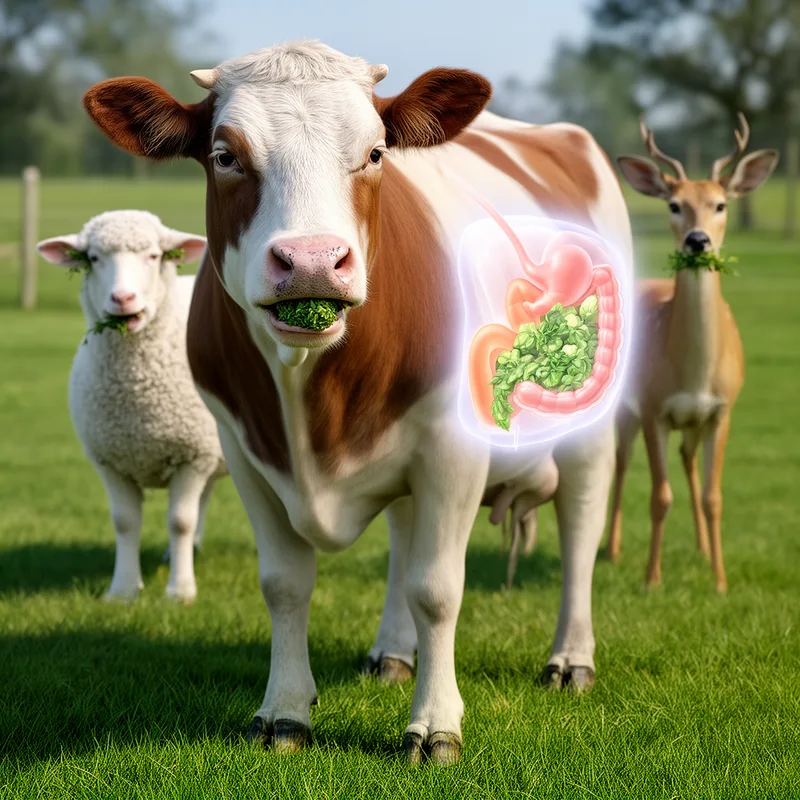
ruminant
 2
7.2

- noun
- /ˈruːmɪnənt/
- Specialized
- Rift Valley fever (RVF) is an acute febrile viral disease that affects domestic ruminants and humans.
- small ruminants
- domestic ruminants
- ruminant farm
Examples
-
Fascioliasis is a common disease of cattle and other ruminants caused by F. hepatica and F. gigantica.
Academic text (2014) -
"We're seeing renderers shift the flow of ruminant protein away from ruminant feed," says Mike Westendorf of Rutgers University.
Academic text (1997) -
Even when he wasn't eating, his jaw moved gently around like the jaw of a ruminant.
Fiction book (1999) -
The DDGS is used as animal feed, particularly for ruminants (mainly dairy and beef cattle).
Academic text (2008) -
Forage crops, pasture, and rangelands are important in feeding ruminant animals tied to the meat and dairy industries.
Academic text (2005) -
Almost all of these species are ruminants, a type of mammal with four chambered stomachs that yield large quantities of milk.
-
Molasses is appropriate for feeding ruminants as it is appetizing and manageable to utilize.
Academic text (2015) -
Ruminants (PPR) is an acute contagious viral disease of small ruminants and is causing heavy economic losses to the goat industry.
Academic text (2014) -
Ruminal acidosis is a metabolic disorder caused by feeding errors in ruminants that may be manifested in acute or subacute form.
Academic text (2013) -
Cows, as ruminants, chew their cud to aid digestion and maintain health.
Surface Forms
Morphology
Etymology
Ruminant comes from the Latin verb ruminare, which means 'to chew the cud' or 'chew again'. That's why a ruminant is a hoofed animal like a cow or sheep that brings food back up to chew it again.