
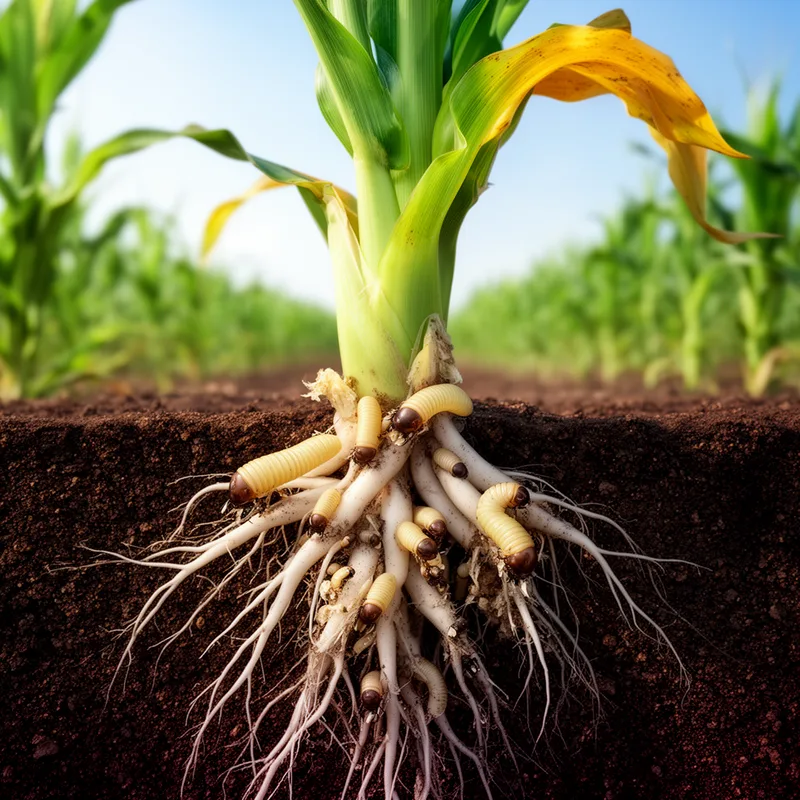
rootworm
 1
7.3

- noun
- /ˈruːtˌwɜrm/
- Specialized
- The damage caused by rootworm larvae can lead to significantly reduced yields in maize fields.
- corn rootworm
- western corn rootworm
- rootworm beetle
Loading YouTube…
Watch on YouTubeAnd by doing that, that protein that that corn would now make causes rootworm to die when they eat the corn.
- And by doing that, that protein that that corn would now make causes rootworm to die when they eat the corn.
Examples
-
Chandler is co-chair of the special corn rootworm areawide management committee, along with Richard L. Dunkle, who is director of the ARS Midwest Area.
Academic text (1997) -
Corn rootworms are the first pest to evolve a way to defeat crop rotations.
Academic text (2003) -
And by doing that, that protein that that corn would now make causes rootworm to die when they eat the corn.
-
Rootworms would not lay eggs in soybeans, so corn planted after soybeans would not be at risk of rootworm damage.
Academic text (1997) -
In the past, to avoid a buildup of rootworms, some farmers planted soybeans instead of corn in alternating years.
Academic text (1997) -
In an Iroquois County, Illinois, soybean field, scout Bob Schimmel counts the number of western corn rootworm adults on a yellow sticky trap.
Academic text (1997) -
The granules would target rootworms and late-stage beetle larvae and pupae in the soil.
Academic text (1994) -
Purdue University entomologist Wayne Buhler and grower Urszula Zumwalt examine a corn ear for silk damage caused by western corn rootworm beetles.
Academic text (1997) -
Farmers often use pesticides to control rootworm infestations that harm their corn crops.
-
To prevent rootworm damage, many farmers rotate their crops each season.
Synonyms
 13
6.1
A soft, thick young insect that lives in soil or rotting wood

 1
7.2
A large beetle that appears in late spring whose larvae eat plant roots and can damage lawns
 1
9.6
A long thin young insect that eats plant roots and can damage crops
 1
8.6
A beetle whose young eat plant roots and can damage lawns
Surface Forms
Morphology
Etymology
Rootworm is made of two simple words: root, meaning 'the part of a plant under the ground', and worm, meaning 'a small insect or its young that eats plants'. So a rootworm is an insect that eats plant roots and often damages crops.