
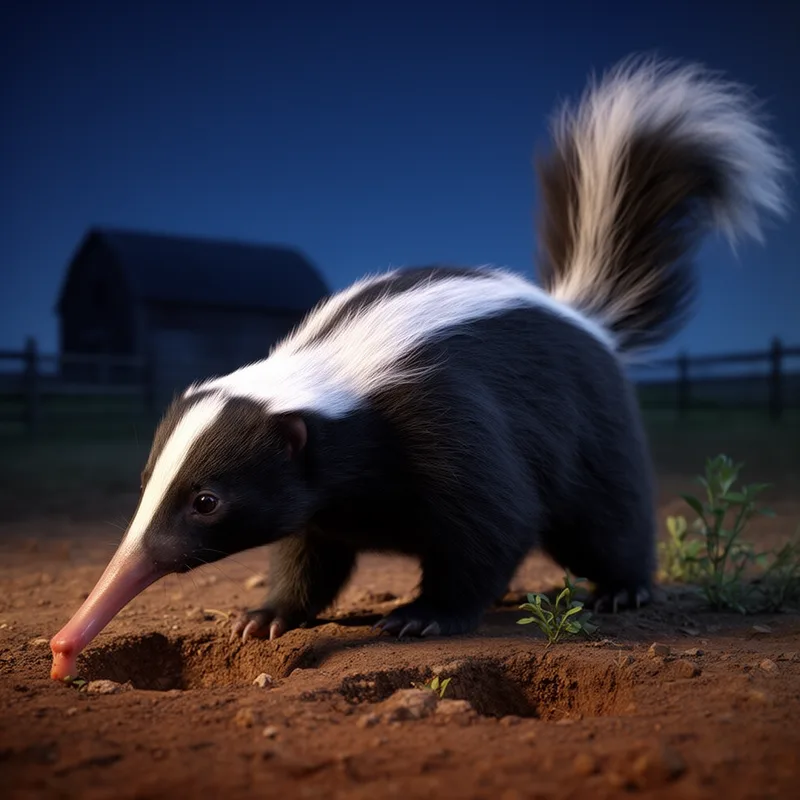
rooter skunk
- noun
- /ˈruːtər skʌŋk/
- US
- The rooter skunk is easily recognized by its long snout and striking white stripe.
Examples
-
Researchers tracked the movements of a rooter skunk to study its foraging behavior.
-
I saw a rooter skunk while hiking in Arizona.
-
Farmers in the region often spot rooter skunks searching for food at night.
-
The rooter skunk is native to the deserts of Mexico.
-
Farmers in the region often spot rooter skunks searching for food at night.
-
Researchers tracked the movements of a rooter skunk to study its foraging behavior.
-
The rooter skunk is easily recognized by its long snout and striking white stripe.
Synonyms

A large skunk with a long nose and white back and tail from southwestern North America and Mexico

A large skunk with a bare, pig-like snout and a white back and tail from southwestern North America

A large skunk with a bare pig-like nose and a white back and tail from southwestern North America

A large skunk with a bare nose and white back and tail found in southwestern North America and Mexico
Surface Forms
Morphology
rooter + skunk
The constituent 'skunk' is clear, but 'rooter' is not a common dictionary word; at best a learner who knows 'root' + -er could infer ‘one that roots’ and guess this is a skunk that forages or roots in the ground. However, the specific species features in the definition (naked muzzle, white back and tail, geographic range) are not predictable from the parts, so comprehension would be partial rather than fully transparent.
Etymology
Rooter skunk gets its name from the animal's way of using a long snout to 'root' or dig in the ground for food; rooter shows the digging and skunk names the striped animal. That's why the term refers to a large skunk with a long, bare muzzle and a white back and tail.

