
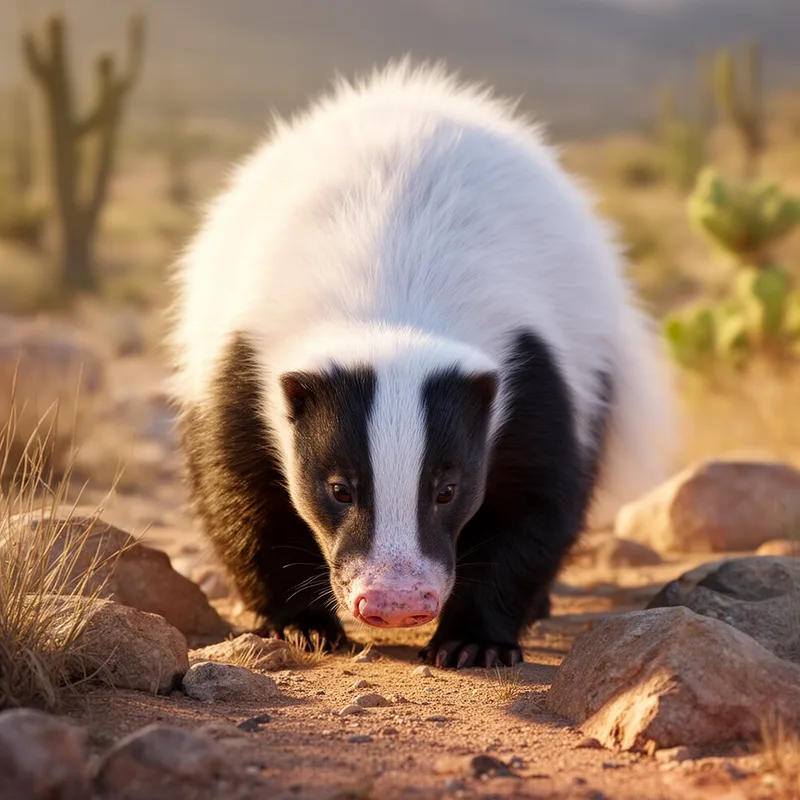
badger skunk
- noun
- /ˈbædʒər skʌŋk/
- US
- Unlike other skunks, the badger skunk has a distinctively naked muzzle and a white tail.
Examples
-
The badger skunk can be found throughout arid regions of southwestern North America.
-
Researchers observed a badger skunk foraging for food along the rocky terrain.
-
The badger skunk is known for its distinctive appearance.
-
Many badger skunks have been spotted in Arizona.
-
Researchers observed a badger skunk foraging for food along the rocky terrain.
-
The badger skunk can be found throughout arid regions of southwestern North America.
-
Unlike other skunks, the badger skunk has a distinctively naked muzzle and a white tail.
Synonyms

 31
1.0
31
1.0

A small black and white mammal that sprays a strong bad smell
A large skunk with a long nose and a white stripe on its back and tail

A large skunk with a long nose and white back and tail from southwestern North America and Mexico
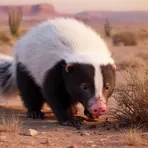
A large skunk with a bare, pig-like snout and a white back and tail from southwestern North America

A large skunk with a bare pig-like nose and a white back and tail from southwestern North America

A group of skunks with long snouts found in the Americas
Surface Forms
Morphology
The phrase names a specific animal by combining 'badger' and 'skunk', so its meaning (a skunk with badger-like features) is directly and compositionally derived from the constituent nouns. This type of descriptive compound is common cross-linguistically, so a B1 learner who knows both words can infer the general referent even if they lack precise taxonomic or regional knowledge.
Etymology
Badger skunk comes from how the animal looks: it has a bare muzzle like a badger and a white back and tail like a skunk, so people joined the two names. That's why the name refers to this particular skunk with those features.