

hognosed skunk
- noun
- /ˈhɔɡˌnoʊzd skʌŋk/
- US
- The hognosed skunk is easily recognized by its pig-like snout and striking coloration.
Examples
-
Unlike other skunk species, the hognosed skunk prefers open habitats and grassy plains.
-
Farmers in the region sometimes spot a hognosed skunk searching for insects at night.
-
The hognosed skunk is known for its unique appearance.
-
Have you ever seen a hognosed skunk in the wild?
-
Farmers in the region sometimes spot a hognosed skunk searching for insects at night.
-
The hognosed skunk is easily recognized by its pig-like snout and striking coloration.
-
Unlike other skunk species, the hognosed skunk prefers open habitats and grassy plains.
Synonyms
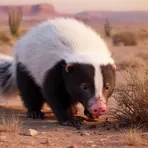
A large skunk with a bare, pig-like snout and a white back and tail from southwestern North America

A large skunk with a long nose and white back and tail from southwestern North America and Mexico
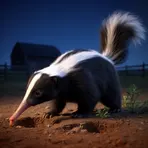
A large skunk with a long nose and a white stripe on its back and tail

A large skunk with a bare nose and white back and tail found in southwestern North America and Mexico

A group of skunks with long snouts found in the Americas
Surface Forms
Morphology
hognosed + skunk
Although 'hognosed' is not attested in the provided dictionary entry, it is transparently analyzable as 'hog‑nosed' = 'having a snout like a hog', so a learner who knows 'hog'/'nose' and 'skunk' can infer 'a skunk with a hog‑like snout'. This is a straightforward compositional animal-description pattern common cross-linguistically, so the meaning is immediately derivable by B1 learners who know the parts.
Etymology
The name hognosed skunk may come from its nose: the animal has a long, bare nose that looks like a pig's, so people called it hog, nosed, skunk. So the name describes this particular skunk with a 'pig-like nose' today.

