

rock lobster


 1
3.8
1
3.8
- noun
- /rɑk ˈlɒbstər/
- Australian
 :
langosta espinosa
:
langosta espinosa
- At the seafood market, you can find live rock lobsters ready for cooking.
- Australian rock lobster
Examples
-
On average, each rock lobster was killed within fifteen minutes by more than 300 Burnupena whelks that removed all the flesh in less than an hour.
Academic text (1995) -
The local lobstermen report that twenty years ago, rock lobsters were equally common on both islands.
Academic text (1995) -
I got very nice rock lobsters this morning.
-
Several hundred were observed being attacked immediately after release, and a week later no live rock lobsters could be found at Marcus Island.
Academic text (1995) -
The apparently healthy rock lobsters were quickly overwhelmed by large numbers of whelks.
Academic text (1995) -
They're actually little spiny rock lobsters.
-
One thousand rock lobsters from Malgas Island were tagged and transferred to Marcus Island.
Academic text (1995) -
The rock lobsters escaped temporarily by swimming, but each contact with the substratum resulted in several more whelks attaching themselves until the weight of numbers prevented escape.
Academic text (1995) -
I enjoyed a delicious meal of rock lobster at the seaside restaurant last night.
-
The chef prepared a gourmet dish with fresh rock lobster and herbs from the garden.
Synonyms
 8
9.3
8
9.3
A large spiny sea animal like a lobster that people eat
 1
4.2
1
4.2
A large sea animal with a spiny shell and no big claws, often eaten in warm seas
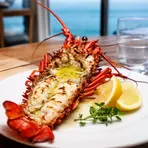
A large spiny lobster without big claws that people eat
Surface Forms
Morphology
rock + lobster
This is a straightforward noun–noun compound: 'rock' modifies 'lobster' to indicate the type or habitat, so a learner who knows 'rock' and 'lobster' can infer it refers to a lobster associated with rocks (i.e. a spiny lobster). The compositional modifier pattern is common in English and cross-linguistically familiar, making the meaning readily derivable for a B1 learner.
Etymology
Rock lobster comes from where the animal lives: these lobsters hide between rocks on warm coasts. That's why rock lobster means the large spiny lobster with no big claws that lives on rocky shores.