

rhizopod
- noun
- /ˈraɪzəˌpɒd/
- Archaic
- In the pond, we found several rhizopods that were moving using their pseudopodia to capture tiny food particles.
Examples
-
The scientist studied a variety of rhizopods under the microscope to learn more about their feeding habits.
-
During the biology class, we learned that rhizopods are important for understanding the evolution of cellular movement.
-
Then, with lowering temperatures come the seaweeds and the rhizopods, then the land plants and the lunged vertebrates.
Academic text (1996)
Synonyms
 1
7.9
1
7.9

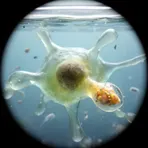
A tiny animal made of one cell that moves and eats by forming temporary arms
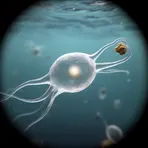
A tiny single-celled animal that moves and eats using temporary arm-like parts

A one-celled animal that moves and eats using temporary arm-like parts

A single-celled animal that moves and eats by making temporary extensions of its body called pseudopods
Surface Forms
Morphology
rhizopod = rhizo + pod (opaque) = rhizo + pod
The components 'rhizo' and 'pod' are not commonly recognized by learners, and the specific biological meaning is specialized.
Etymology
Rhizopod comes from Greek parts rhiz- meaning 'root' and -pod meaning 'foot', the same -pod in tripod. So a rhizopod is like a tiny creature with 'root-like feet' — the thin parts it pushes out to move and eat.