
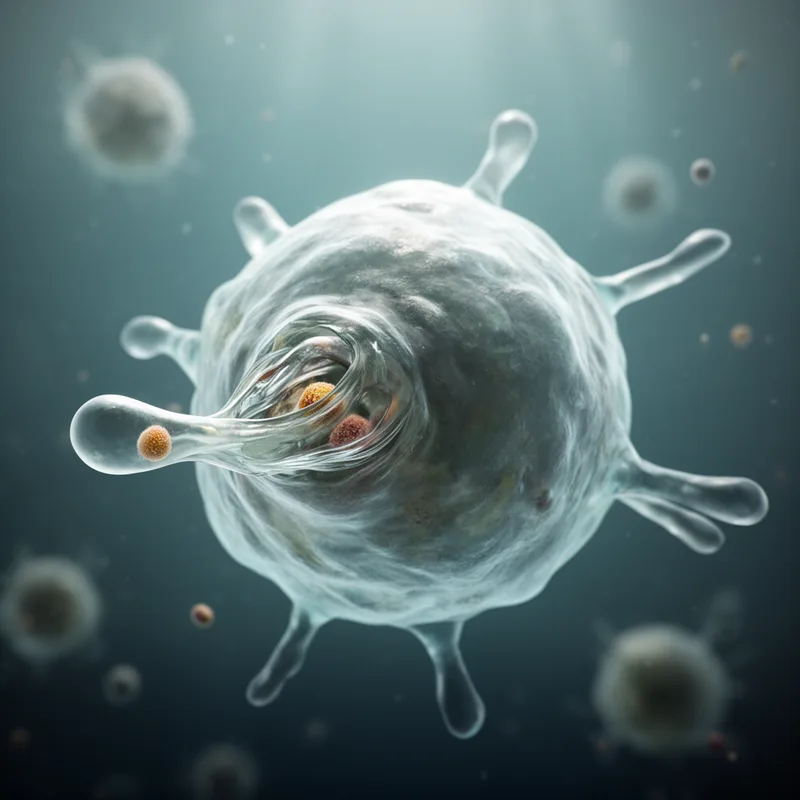
sarcodinian
- noun
- /sɑrˈkoʊdɪnɪən/
- Archaic
- The biologist observed a sarcodinian under the microscope as it formed pseudopods to engulf food.
Examples
-
Many sarcodinians play important roles in marine ecosystems by feeding on bacteria and organic matter.
-
In the lab, students studied the behavior of the sarcodinian, noting how it adapted its shape to move through water.
-
PHOTO (BLACK & WHITE): Figure 21. Different stages of a sarcodinian amoeba, Figure 34, p. 25, from Bovee and Sawyer (1979).
Academic text (1996)
Synonyms

A single-celled animal that moves and eats by making temporary extensions of its body called pseudopods
A tiny single-celled animal that moves and eats using temporary arm-like parts
A tiny single-celled animal that moves and eats using arm-like parts

A tiny single-celled sea animal with a glass-like skeleton and thin arms

A single-celled creature with stiff rod-like arms that spread out to move and feed
A one-celled creature with a round body and long thin arms that lives in fresh water like ponds
Surface Forms
Morphology
sarcodinian = Sarcodina (opaque) = sarcod + ian
A technical scientific formation using a combining form ('sarcod-') and the suffix '-ian' which is not recognizable to average learners, so the meaning cannot be derived from common English vocabulary.
Etymology
Sarcodinian comes from the Greek root sarc- meaning 'flesh', a nod to the soft, changing body of these tiny organisms. So a sarcodinian is a single-cell animal that moves and eats by pushing out soft, 'flesh-like' arms called pseudopods.

