
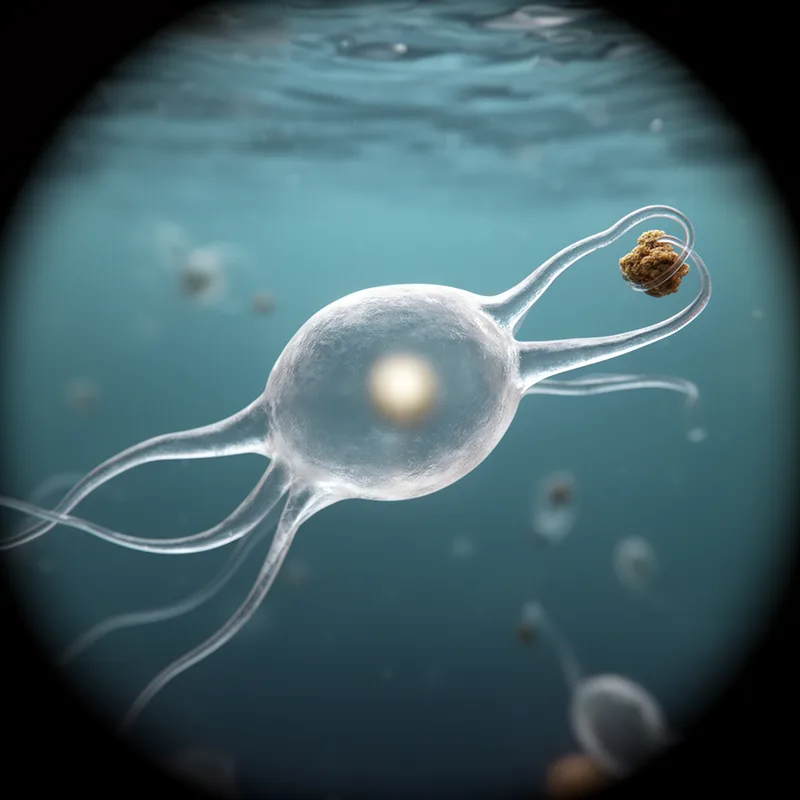
rhizopodan
- noun
- /ˌraɪzoʊˈpoʊdən/
- Archaic
- The rhizopodan can move through the water using its pseudopods.
Examples
-
Scientists observed the feeding behavior of a rhizopodan under the microscope.
-
Many rhizopodans are found in freshwater environments.
-
Many rhizopodans play an essential role in aquatic ecosystems.
-
The rhizopodan moves by extending its pseudopodia to form temporary projections.
-
Many rhizopodans play an essential role in aquatic ecosystems.
-
Scientists observed the feeding behavior of a rhizopodan under the microscope.
-
The rhizopodan moves by extending its pseudopodia to form temporary projections.
Synonyms
 1
7.9
1
7.9

A tiny animal made of one cell that moves and eats by forming temporary arms
A tiny single-celled animal that moves and eats using arm-like parts

A one-celled animal that moves and eats using temporary arm-like parts

A single-celled animal that moves and eats by making temporary extensions of its body called pseudopods

A one-celled creature with a round body and long thin arms that lives in fresh water like ponds

A single-celled creature with stiff rod-like arms that spread out to move and feed

A tiny single-celled sea animal with a glass-like skeleton and thin arms
Surface Forms
Morphology
rhizopodan = rhizopod (opaque) = rhizo + pod + an
The formation 'rhizopod' + '-an' is a regular noun-forming/suffixed pattern, but the base is a technical combining form unfamiliar to average learners.
Etymology
The word rhizopodan comes from Greek parts rhizo- meaning 'root' and -pod meaning 'foot', because these tiny single-celled creatures move and feed with root-like extensions called pseudopods, or 'false feet'. So a rhizopodan is a creature that reaches out with these root-like 'feet' to move and eat.