

repulsive force
 1
6.7
1
6.7

- noun
- Specialized
- When the two charged particles approached, the strong repulsive force pushed them apart.
Loading YouTube…
Watch on YouTubeAnd therefore physicists postulate some repulsive force pushing it apart that we call dark energy.
- And therefore physicists postulate some repulsive force pushing it apart that we call dark energy.
- And so there there is postulated a kind of repulsive force, which we refer to as dark energy.
Examples
-
For the past five billion years, the expansion of the universe has been powered by a mysterious repulsive force known as "dark energy."
Blog text (25) -
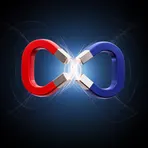
The scientists discovered that the repulsive force between the two magnets caused them to push away from each other.
-
The net effect is a strong repulsive force.
Academic text (2006) -
So what is the nature of the repulsive force that dark energy produces?
-
There must be some repulsive force that's keeping it from falling toward the earth.
-
The increasing rate of expansion indicates very clearly that there is a large-scale repulsive force driving the expansion of the Universe.
Blog text (3) -
This phenomenon confirms the importance of repulsive forces in maintaining a stable system.
Academic text (2018) -
And therefore physicists postulate some repulsive force pushing it apart that we call dark energy.
-
The cosmological constant acts like a repulsive force that increases with distance, while the ordinary attractive force of gravitation decreases with distance.
Academic text (2005) -
In physics, a repulsive force can be observed when like charges repel each other.
Synonyms
 3
5.3
3
5.3
A quality that makes people or things stay away
 3
6.4
3
6.4
A force that pushes objects away from each other

A force that pushes objects away from each other, like between magnets
Antonyms
- Specialized

 1
4.7
1
4.7
A pull that makes two things move toward each other, like gravity or magnets
Surface Forms
Morphology
The meaning is directly derivable from 'repulsive' (pushing away) + 'force' (a power causing movement); the adjective+noun composition transparently describes a force that pushes objects apart. This compositional pattern is common across languages and follows standard English semantics, so a B1 learner who knows the constituents should understand it.
Etymology
Repulsive force comes from the image of two things pushing each other away, like two magnets that turn their ends away and cannot touch. So, repulsive suggests 'pushing back' and force is the push, which is why the phrase means a 'force' that makes bodies 'push away' from each other.