
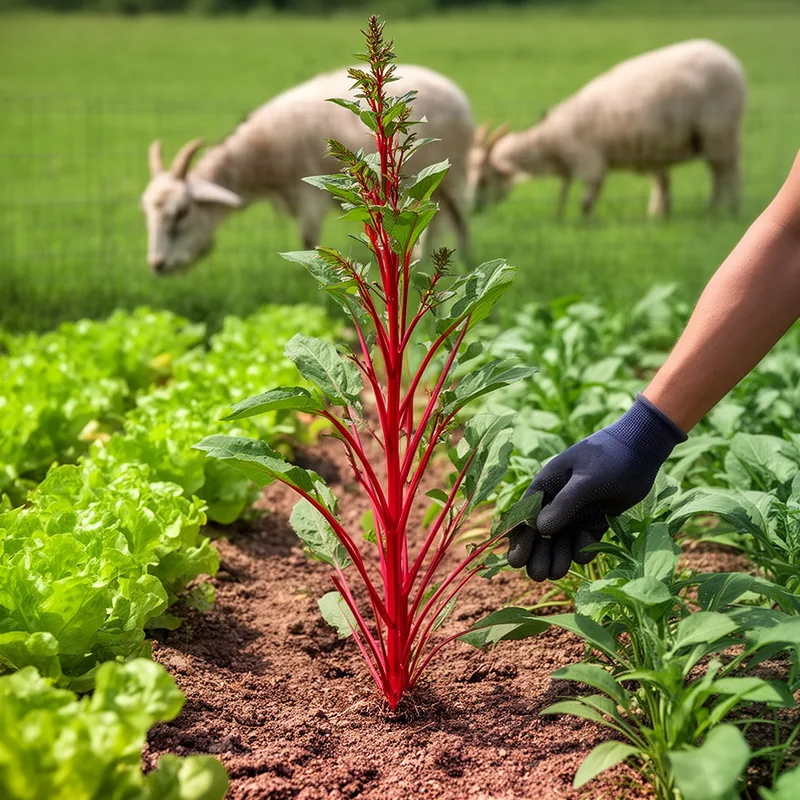
red goosefoot
- noun
- UK
- Gardeners often remove red goosefoot to prevent it from competing with vegetables.
Examples
-
Farmers consider red goosefoot a troublesome weed.
-
Some wild birds feed on the seeds of red goosefoot in late summer.
-
The field was full of red goosefoot growing among the crops.
-
The red goosefoot is often found in disturbed soils.
-
Gardeners often remove red goosefoot to prevent it from competing with vegetables.
-
Some wild birds feed on the seeds of red goosefoot in late summer.
-
Farmers consider red goosefoot a troublesome weed that can damage their crops.
Synonyms

A flowering plant called red goosefoot that grows wild in Europe, Asia, and North America

A small wild plant with triangular or diamond shaped leaves and small green flowers often seen as a weed

A group of flowering plants like goosefoot, some grown for food and others as weeds
Surface Forms
Morphology
This is a straightforward attributive noun phrase: 'red' simply modifies the head noun 'goosefoot', so a learner who knows both words will infer it denotes a goosefoot plant that is red or has red stems. The meaning is fully compositional and follows common cross-linguistic color + noun naming patterns, so it is immediately understandable to B1 learners who know the constituents.
Etymology
Red goosefoot gets its name from a simple picture: it has red stems and leaves that look like a goose's foot, so the parts red and goosefoot describe how it looks. So the name helps you remember that it is a reddish field 'weed' that can compete with crops and may be 'poisonous' to animals.

