
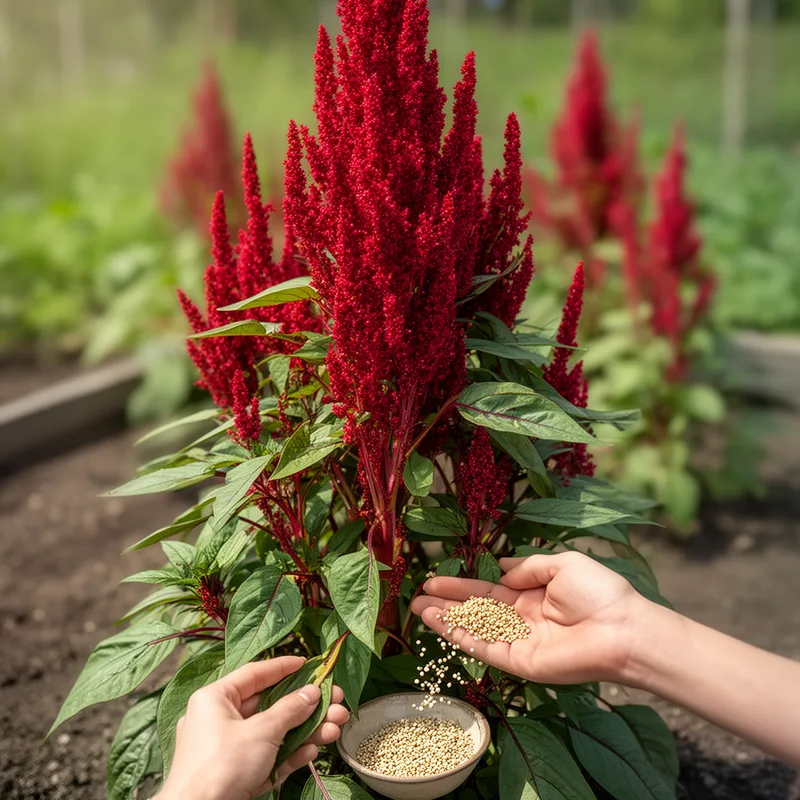
red amaranth
- noun
- /rɛd ˈæməˌræntθ/
- Specialized
- In many cuisines, red amaranth is prized for its vibrant leaves and nutritious seeds.
Examples
-
Gardeners often choose red amaranth for its striking appearance and easy growth.
-
The seeds of red amaranth can be ground into flour or cooked as a cereal.
-
The red amaranth blooms beautifully in the summer.
-
I saw a red amaranth plant in Maria's garden.
-
Gardeners often choose red amaranth for its striking appearance and easy growth.
-
In many cuisines, red amaranth is prized for its vibrant leaves and nutritious seeds.
-
The red amaranth blooms beautifully in the summer.
Synonyms

 1
9.9
1
9.9

A tall garden plant with long colorful flower spikes

A tall tropical plant with hairy stems and long red flower spikes whose seeds are used like cereal
A tall American annual with hairy stems, long red flower spikes, and seeds used as cereal
A tall plant with red flower spikes whose leaves people eat and whose seeds people use for food
A tall tropical plant with long red flower spikes and purple leaves whose seeds are eaten as cereal

A tall tropical plant with long red flower spikes and edible seeds

A tall plant with purple leaves and red flower spikes whose seeds people eat
Surface Forms
Morphology
The phrase is a straightforward adjective + noun describing the color variant of the plant: 'red' (color) combined with 'amaranth' (the plant) yields the expected meaning. This compositional pattern is regular in English (and cross-linguistically common), with no idiomatic or metaphorical shift, so a learner who knows both words would understand it.
Etymology
Red amaranth gets its name from the plant's bright colour and an old word for a flower that 'does not fade'. One popular story says amaranth comes from a Greek word meaning 'unfading' because the flowers keep their colour, and the red part simply marks the red variety, so the name tells you it is a long-lasting red plant often used for food or decoration.