
to recontextualize


 1
8.3
1
8.3
- verb
- /ˌriːˌkɒnˈtɛkʧuəlaɪz/
- Jargon
- So to understand agoraphobia in James's terms, we have to recontextualize the fear, put it back in its proper place, or rather, time.
- recontextualized discourses
Loading YouTube…
Watch on YouTubeAnd so suddenly your brain remaps, recontextualizes the whole thing.
- And so suddenly your brain remaps, recontextualizes the whole thing.
- And this is basically recontextualizing the scientific method.
Examples
-
But as King Lear makes evident, the fabula had eventually to be recontextualized to comprehend the increasing importance of women.
Academic text (1992) -
To fully appreciate the artwork, critics must recontextualize it within the cultural movements of the time.
-
And this is basically recontextualizing the scientific method.
-
We do not so much forget the events of our past as we reinterpret and recontextualize them.
Academic text (2011) -
But I think the way that you have recontextualized these drawings is really striking.
-
Once any artwork is recontextualized, there are a thousand or more clues that contributed to its creation.
Blog text (10) -
Globalization has generally recontextualized local music traditions across the world.
Academic text (2011) -
Contemporary performance and teaching practices demonstrate that traditions can be successfully recontextualized.
Academic text (2011) -
Kevin Brand's Piet recontextualizes Sam Nzima's photograph on the wall of the Castle of Good Hope in Cape Town.
Academic text (2007) -
The panadera typically recontextualizes or alters her citations of heroic conventions to imply her target's effeminacy.
Academic text (2003)
Synonyms
 66
4.9
66
4.9
To give something a new meaning that changes how people see it
 14
4.8
14
4.8
Change the way you think about something to see it in a better way
 10
5.8
10
5.8
To explain something again in a different way to give it a new meaning
 9
4.7
9
4.7
Think of something in a new way
 7
6.3
7
6.3
To put information into its background so people understand it better
 1
8.1
1
8.1
To think about something in a new way
 1
7.0
1
7.0
To change an idea, story, or image to fit a new setting

To place something in a new context so people see it differently

To give a person or idea a new place in history
To change what something means or how people see its worth
Antonyms
 1
9.0
1
9.0
To remove something from the situation where it came from so people can understand or use it on its own
How Reinterpreted

Surface Forms
Morphology
recontextualize = contextualize (semi-transparent) = re + context + ual + ize
The prefix 're-' adds the meaning 'again' transparently, but the base verb 'contextualize' is a multi-step derivation (context + -ual + -ize) that may not be fully obvious to intermediate learners.
Etymology
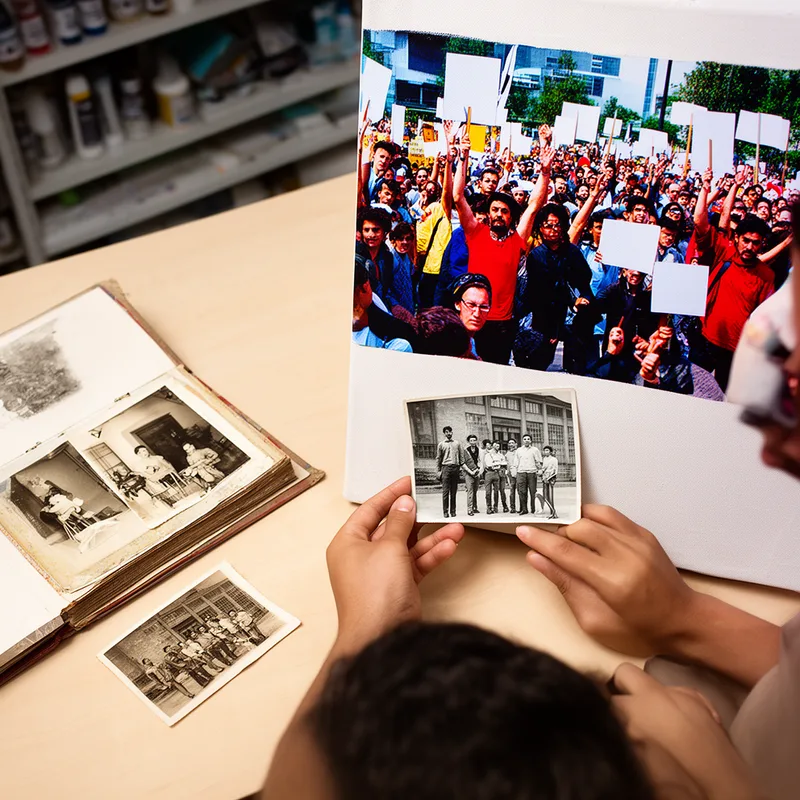
The word recontextualize breaks into re- 'again', context 'the situation or setting around something', and -ize 'to make'. Think of moving a photo into a new frame: putting something in a new context changes how we understand it, which is what it means to recontextualize.