
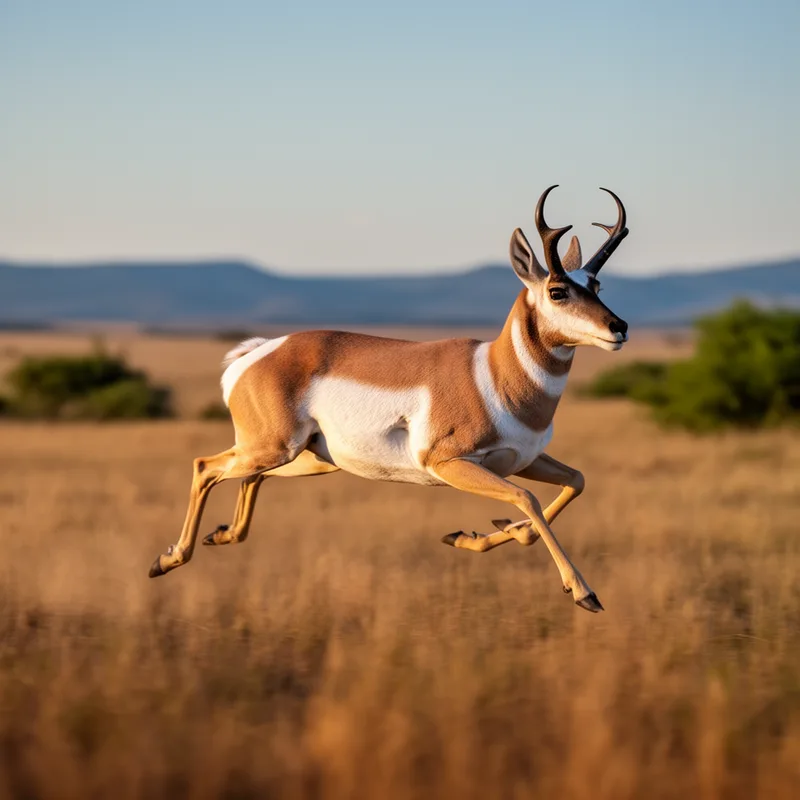
pronghorn
 3
8.4
3
8.4

- noun
- /ˈprɔŋˌhɔrn/
- US
- The pronghorn is swift and can run at speeds of up to 60 miles per hour to escape predators.
- Sonoran pronghorn
- pronghorn horns
- wild pronghorn
Loading YouTube…
Watch on YouTubeThey'll take the last two strings of barbed wire off so the pronghorns can get underneath, but it still keeps out the larger things.
- They'll take the last two strings of barbed wire off so the pronghorns can get underneath, but it still keeps out the larger things.
Examples
-
The Sonoran pronghorn, one of five pronghorn subspecies, may be the most endangered large mammal in the United States.
Academic text (2007) -
Increased numbers do not mean the Sonoran pronghorn is out of the woods.
Academic text (2007) -
Yellowstone pronghorn are the fastest North American land animals, reaching speeds of over 50 miles per hour.
Academic text (2009) -
Indeed, those youngsters were the first captive-born Sonoran pronghorn to be released to the wild.
Academic text (2007) -
Unlike deer, pronghorn have forked horns made of keratin, not antlers, which are bone.
Academic text (2007) -
Captive breeding programs and desert enhancements are starting to revive Sonoran pronghorn numbers.
Academic text (2007) -
The Sonoran subspecies of pronghorn originally ranged from southeastern California and southwestern Arizona into Sonora in Mexico.
Academic text (2007) -
While driving through Wyoming, we spotted a herd of pronghorn grazing peacefully in the fields.
-
During our wildlife tour, the guide pointed out a pronghorn leaping gracefully across the open plains.
Synonyms

 1
8.0
1
8.0
A fast North American animal like an antelope with small forked horns on open plains

A fast animal with hooves like an antelope that lives on western North American plains and has forked horns

An animal like a small antelope with short branched horns that runs fast on open plains
A fast, hoofed animal from western North America called the pronghorn
Compounds
1
8.0
A fast North American animal like an antelope with small forked horns on open plains
How Fast

Surface Forms
Morphology
Etymology
Pronghorn comes from the parts prong, meaning 'the point on a fork', and horn, meaning 'horn'. It was named because the animal's horns have a small fork or branch, so the name points to its forked horns.