
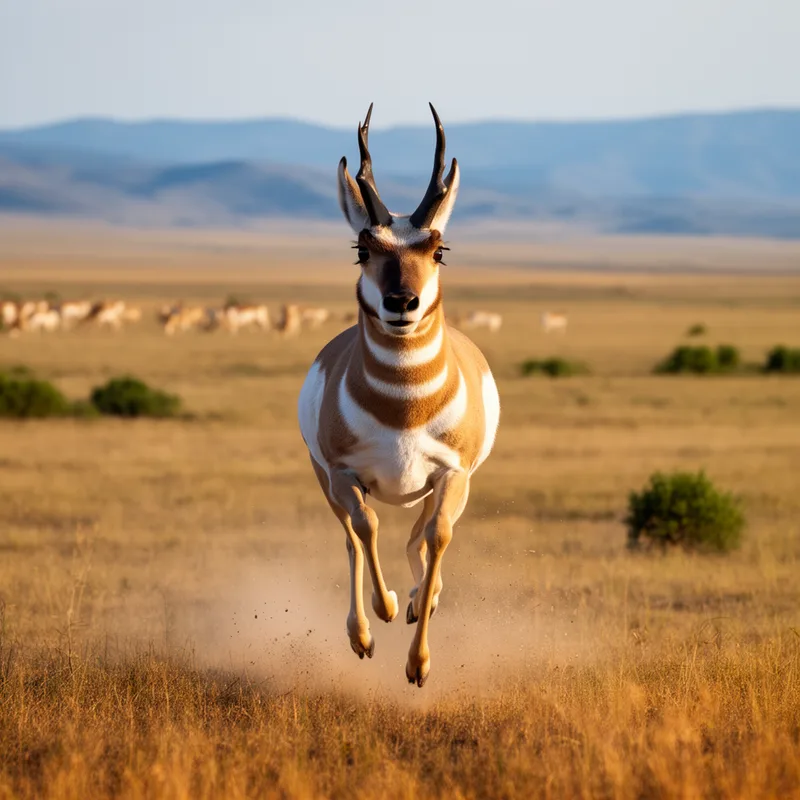
pronghorn antelope


 1
8.0
1
8.0
- noun
- /ˈprɔŋˌhɔrn ˈæntəˌloʊp/
- US
- Many wildlife enthusiasts travel to the West to observe pronghorn antelope in their natural habitat.
- pronghorn antelope and deer
- pronghorn antelope and sheep
- pronghorn antelope and mule
Examples
-
I saw a pronghorn antelope while hiking in Wyoming.
-
Despite its name, the pronghorn antelope is not a true antelope.
-
The pronghorn antelope can outrun most predators on the open plains.
-
We spotted a herd of pronghorn antelope grazing near the foothills.
-
The pronghorn antelope is known for its incredible speed.
-
The swift pronghorn antelope can run at speeds of up to 55 miles per hour across the plains.
-
During the autumn months, pronghorn antelope gather in herds to forage for food.
Synonyms
 3
8.4
3
8.4
A fast, deer-like animal from western North America with small branched horns

A fast animal with hooves like an antelope that lives on western North American plains and has forked horns

An animal like a small antelope with short branched horns that runs fast on open plains

A fast, hoofed animal from western North America called the pronghorn
Surface Forms
Morphology
The compound is directly built from the literal nouns 'pronghorn' and 'antelope', so a learner who knows those words can infer it refers to an antelope-like, fast mammal with forked/branched horns. There is no idiomatic or metaphorical shift—it's a descriptive, compositional noun phrase common across languages—so the meaning is immediately derivable from its parts.
Etymology
The noun pronghorn antelope comes from its horns: each horn has a small prong or fork, so people called the animal a pronghorn. That's why the name points to its forked horns, even though it is 'not a true antelope'.