
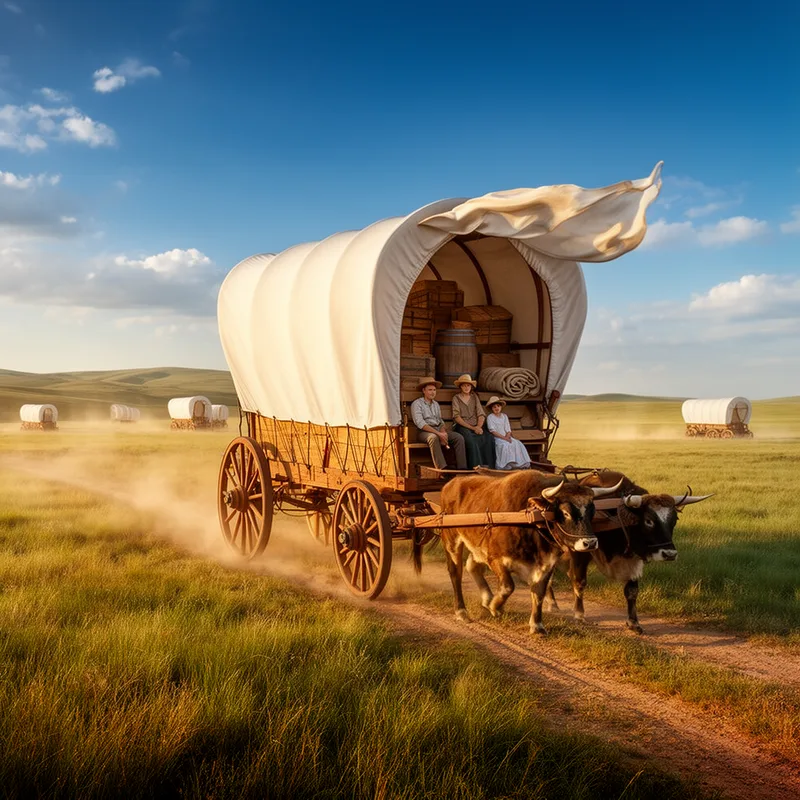
prairie schooner
- noun
- /ˈprɛəri ˈskuːnər/
- Archaic
- With the help of their sturdy prairie schooner, they managed to cross the vast expanse of the Midwest.
Examples
-
The prairie schooners did that after the Civil War; my great-grandfather's among them.
Academic text (2012) -
In the 19th century, pioneers traveled west in their prairie schooners, hoping for a better life.
-
The old photograph showed a family gathered around their prairie schooner on the open plains.
Synonyms
 88
1.0
88
1.0

A four-wheeled vehicle pulled by animals or a tractor to carry goods
 5
5.6
5
5.6
A large wooden wagon with a curved cloth cover used by people to travel across open land


 1
9.9
1
9.9
A large covered wagon with broad wheels used by 1800s American pioneers to carry goods

A large covered wagon with wide wheels used by settlers to travel across the plains

A large covered wagon with wide wheels that early American pioneers used to cross the plains
Surface Forms
Morphology
prairie + schooner
Although 'prairie' denotes grassland, 'schooner' is a sailing vessel, and the MWE is a historical metaphor likening a covered wagon to a ship; the referent 'large covered wagon' is not directly predictable from the literal constituents. The metaphorical and culture‑specific nature of the term makes it unlikely a B1 learner who knows the individual words would infer the intended historical meaning.
Etymology
Prairie schooner got its name from a simple picture: the white canvas top of a covered wagon looked like the 'sails' of a schooner, and the wide grass of the prairie looked like a sea so the wagons seemed to 'sail' across it. That's why the name means a large covered wagon used by people moving west.