

polyhedron
 1
7.8
1
7.8

- noun
- /ˌpɒliˈhiːdrən/
- Specialized
- The teacher explained that the tetrahedron is the simplest type of polyhedron, having four triangular faces.
Loading YouTube…
Watch on YouTubeAnd my project was on relating space filling packings of of polyhedrons.
- And my project was on relating space filling packings of of polyhedrons.
Examples
-
Euler proved in the 18th century that it takes precisely 12 interspersed pentagons to close a sheet of any number of regular hexagons into a polyhedron.
Academic text (1996) -
There are a lot of vertices on that polyhedron, right?
-
So let's say I have polyhedron with F faces.
-
This investigates how the basic polyhedron relates to its associated cluster.
Blog text (8) -
Well then it turns out for convex polyhedra you can do it.
-
And these I made models of these polyhedrons that I had found and here's a close up of them.
-
The immense polyhedron construct from the opening of the film, dappled with its millions of transmitters, drifts overhead.
Fiction book (1997) -
A polyhedron is defined as a three-dimensional shape with flat surfaces, such as a cube.
-
In geometry class, we learned that a polyhedron can have many faces, including triangles and squares.
Compounds

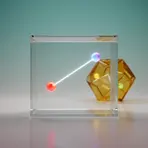
- Specialized
A solid shape with flat faces where any line between two points inside stays inside, for example a cube
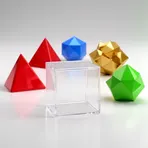
- Specialized
A solid with the same flat faces that are regular polygons and with all angles the same

- Specialized
A solid shape with identical flat faces that are regular polygons like a cube
How Many Faces
- Specialized
1
9.9

- Specialized
1
9.6
- Specialized
1
7.8
130
1.0
- Specialized
2
7.6
Surface Forms
Morphology
polyhedron = poly + hedron
Although the word is built from classical combining forms meaning 'many' and 'face', an average B1 learner is unlikely to know those elements well enough to infer the meaning.
Etymology
The word polyhedron comes from Greek parts poly- meaning 'many' and -hedron meaning 'face' or 'side', like the word polygon which is a flat shape with many sides. So a polyhedron is a three-dimensional solid made of many flat faces.