

tetrahedron
 2
7.6
2
7.6

- noun
- /ˌtɛtrəˈhidrən/
- Specialized
- But in ice, the network of tetrahedrons extends over a long range and becomes a relatively unchanging lattice.
Loading YouTube…
Watch on YouTubeI put one on each face of the tetrahedron, and you get that example.
- I put one on each face of the tetrahedron, and you get that example.
- Tetrahedral numbers are numbers that make a tetrahedron.
- There are hemispheres, cubes, tetrahedrons and flighty wings.
- So there's octahedron, extrahedron through tetrahedrons, dolcahedron, icosahedron.
- And they're like, so the, the tetrahedron poses a question that can only be answered by a four dimensional extrapolation from that.
Examples
-
So let's say that our tetrahedron stops at this point along the Z axis.
-
The tetrahedron that is located inside has neighbors at all of its faces, while the boundary tetrahedron has at least one non-shared face.
Academic text (2016) -
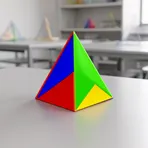
Every face is the same, and a tetrahedron has perfect symmetry.
-
So I have highlighted this tetrahedron using the blue chalk.
-
Each molecule is shaped like a tetrahedron, with the oxygen atom at its center.
Academic text (2007) -
Imagine that the tetrahedron sits on the xy-plane.
Academic text (1994) -
Each of the two hydrogen atoms lies at one of the four corners of the tetrahedron, and each one acts as a center of positive electric charge.
Academic text (2007) -
The group's three-dimensional configuration uses four beams traveling along the threefold symmetry axes of a regular tetrahedron.
Academic text (1994) -
Within a network of tetrahedrons, the number of ways incident energy can create rotations, twists, vibrations, and suchlike significantly rises.
Academic text (2007) -
In geometry, a tetrahedron is defined as a solid shape with four triangular faces.
Compounds
- Specialized
A solid with four triangles, each triangle having three equal sides
How Many Faces
- Specialized
1
9.9

- Specialized
1
9.6
- Specialized
- Specialized
1
8.2
130
1.0
- Specialized
2
7.6
Surface Forms
Morphology
tetrahedron = hedron (semi-transparent) = tetra + hedron
Formed from the combining elements 'tetra-' (four) + '-hedron' (face); the components indicate 'four-faced' but they are not productive standalone English words for average learners.
Etymology
Tetrahedron comes from the Greek parts tetra- meaning 'four' and -hedron meaning 'face' or 'side'. So a tetrahedron is a solid with 'four faces', which is why it has four triangular sides.