
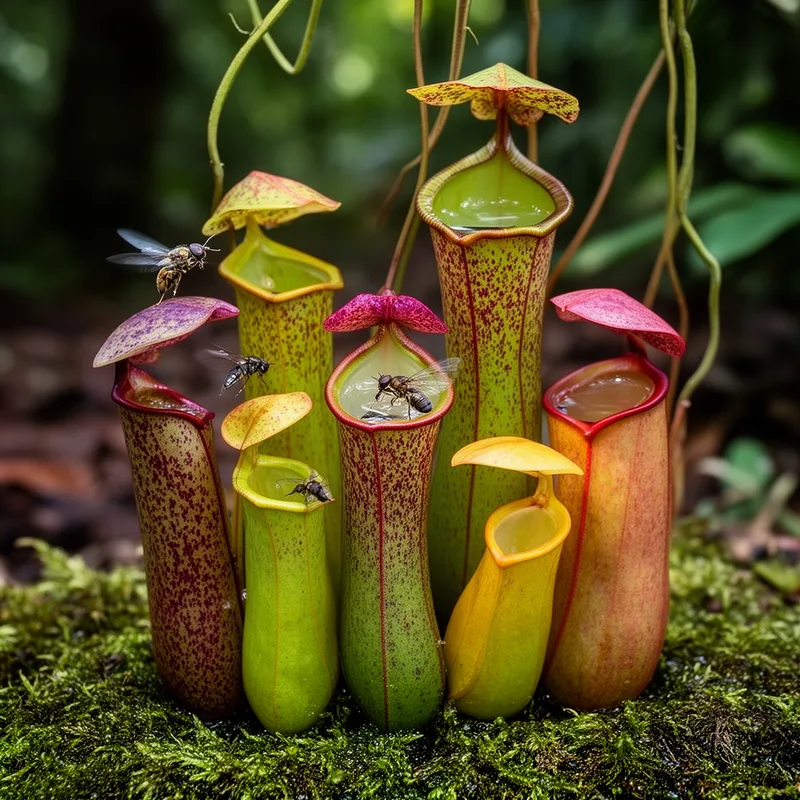
pitcher-plant family
- noun
- /ˈpɪtʃər plænt ˈfæmɪli/
- Specialized
- Plants in the pitcher-plant family can capture and digest insects to supplement their nutrient intake.
Examples
-
The pitcher-plant family includes several species with unusual insect-trapping leaves.
-
Many researchers study the pitcher-plant family to understand their adaptation to nutrient-poor soils.
-
Biologists are fascinated by the diversity within the pitcher-plant family.
-
Nepenthaceae is one of the best-known groups in the pitcher-plant family.
-
Look at that pitcher-plant family!
-
The pitcher-plant family includes several fascinating species.
-
The pitcher-plant family consists of unique plants that attract insects with their tubular leaves.
Synonyms

A group of tropical plants with pitcher-shaped leaves that catch and eat insects

A group of tropical plants that catch insects in cup-shaped leaves

A family of plants that eat insects using pitcher-shaped leaves
How Carnivorous
- Specialized

- Specialized
- Specialized
Surface Forms
Morphology
pitcher-plant + family
This is a straightforward compositional noun phrase: 'family' denotes a taxonomic grouping applied to 'pitcher-plant', so the meaning 'a family of pitcher plants (insectivorous plants with pitcher-like leaves)' is directly derivable from the parts. The 'X family' pattern is common and cross-linguistically transparent, so a B1 learner who knows both constituents would readily understand the phrase.
Etymology
Pitcher-plant family gets its name from plants whose leaves make a deep cup or jug called a pitcher that catches and holds insects. Because many related plants have this 'insect-eating' pitcher, they are grouped as a 'family', so the name means a group of plants that trap insects.

