
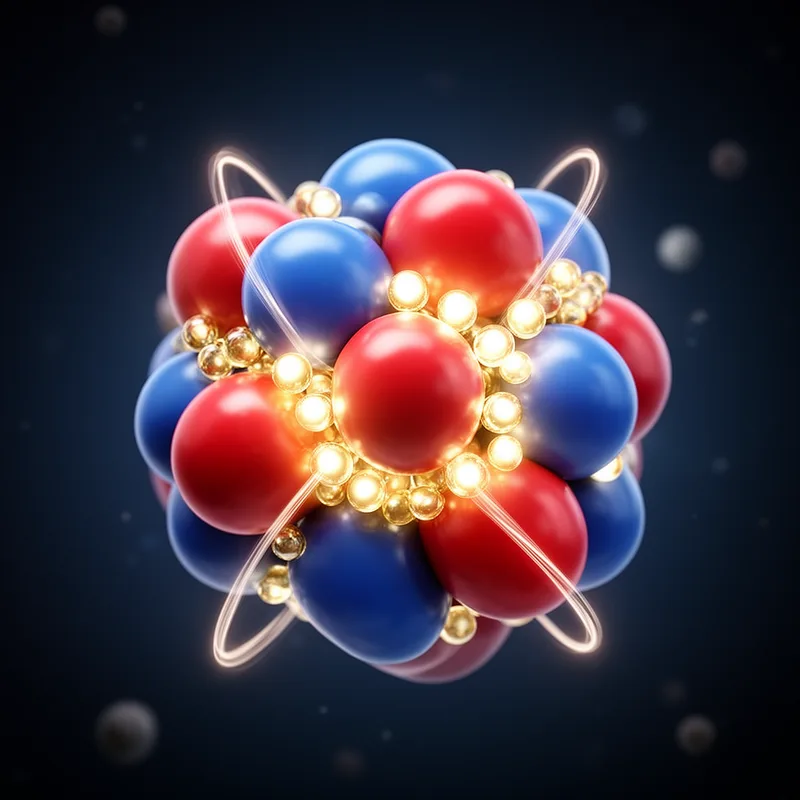
pi-meson
- noun
- /paɪˈmɛzɒn/
- Specialized
- The pi-meson plays a vital role in the nuclear forces that bind protons and neutrons together.
Examples
-
The decay of a pi-meson provides valuable information about fundamental particle interactions.
-
High-energy collisions in particle accelerators can produce a pi-meson.
-
The pi-meson is essential for nuclear stability.
-
Scientists study pi-mesons to understand particle interactions.
-
High-energy collisions in particle accelerators can produce a pi-meson.
-
The pi-meson plays a vital role in the nuclear forces that bind protons and neutrons together.
-
The decay of a pi-meson provides valuable information about fundamental particle interactions.
Synonyms

 1
9.9
1
9.9

A very small particle inside atoms that helps hold the centre of the atom together
Surface Forms
Morphology
Etymology
Pi-meson comes from meson, a Greek word meaning 'middle', because mesons have a mass between light electrons and heavier protons, and from pi, the Greek letter used to name this particular meson (often called a 'pion'). So a pi-meson is the 'middle' particle that helps hold the atomic nucleus together.