

pion
 1
9.9
1
9.9

- noun
- /ˈpaɪɒn/
- Specialized
- The annihilation of a proton by collision with a nucleon typically produces 3-4 charged pions.
- pion decay
- pion photoproduction
- neutral pions
Examples
-
For nuclear collisions at RHIC, the intensity can be measured in terms of the number of particles (mostly pions) emitted into a given interval of solid angle.
Academic text (2003) -
In high-energy physics experiments, a pion plays a crucial role in holding atomic nuclei together.
-
In green we have a charge Hadron, for example a pion, which can have a positive charge.
-
If the pions could be produced economically, this could be the key to almost unlimited energy.
Academic text (2011) -
A central collision at RHIC typically creates thousands of pions and other elementary particles.
Academic text (2003) -
Such a pion soon decays into photons, while the positron and electron could annihilate into more photons.
Academic text (1992) -
A so-called disordered chiral condensate could occur, producing pions that could radiate coherently (a pion laser).
Academic text (1999) -
In the so-called Skyrme model, where the nucleon is a soliton in the pion field, Sigma is very small, so that nearly all of the nucleon's spin comes from quark orbital motion within pions.
Academic text (1995) -
During particle collisions, many pions are produced as evidence of the strong force at work.
-
Scientists observed that different types of pions can decay into other particles during high-energy interactions.
Synonyms
 5
9.9
5
9.9
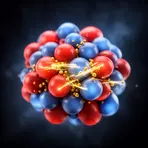
A small particle in the nucleus that helps hold it together
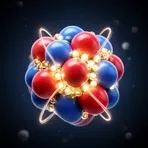
A small particle that helps hold the center of an atom together
How Massive

Surface Forms
Etymology
Pion comes from the old name 'pi meson' — pi is the Greek letter used to name the particle and meson comes from a Greek root meaning 'middle'. So a pion is the 'pi' particle of middle mass that helps hold the nucleus together.