
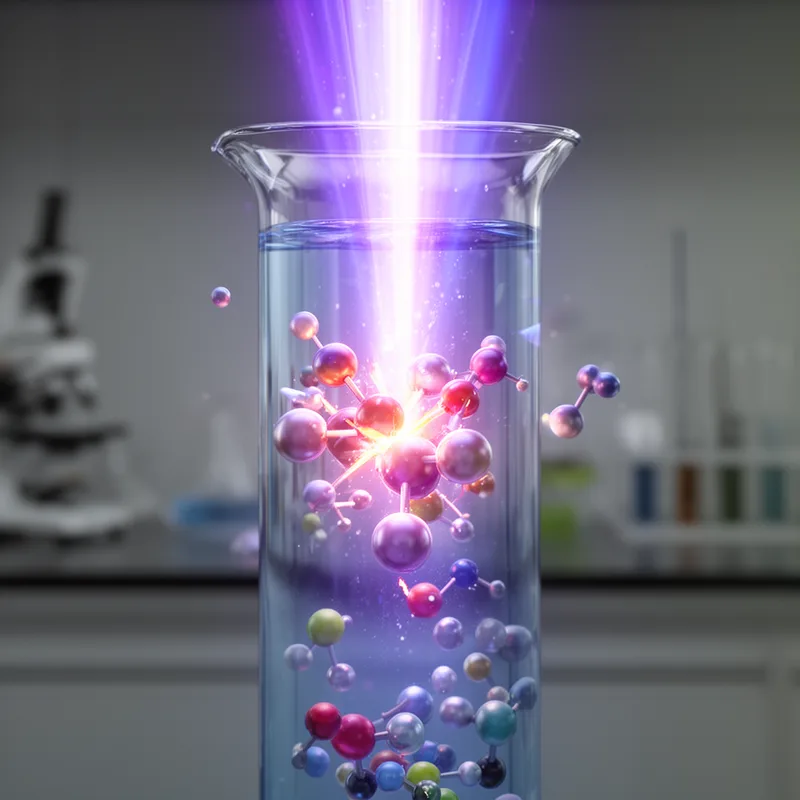
photolysis


 1
9.1
- noun
- /fəˈtoʊlɪsɪs/
- Specialized
- Water is broken down by a process called photolysis, and H2 escapes, and gases are not absorbed back into the rock as they are on Earth.
Examples
-
It should be noted that in all cases, the primary outgassing products are not attributable to the products of deprotection, but rather are the consequence of PAG photolysis.
Academic text (2001) -
The process of photolysis plays a crucial role in the carbon cycle by facilitating the decomposition of organic materials in the presence of sunlight.
-
Acid generated by photolysis undergoes a large number of chemical reactions without being consumed in one reaction.
Academic text (2001) -
The counter ion in this case is formed during photolysis of the photoacid generator and has the same initial spatial distribution as the protons.
Academic text (2001) -
Once chlorine is liberated from the CFC by UV photolysis, it can catalytically destroy ozone.
Academic text (1998) -
Their stability means that CFCs can only be destroyed through photolysis by the extremely energetic UV that exists above most of the ozone layer in the upper stratosphere.
Academic text (1998) -
It is widely recognized that rotenone is chemically unstable and degrades rapidly in the environment through abiotic mechanisms (photolysis and hydrolysis).
Academic text (2008) -
After coating, the PAG and base are present at a concentration that is uniform with depth in the resist film. During exposure, the PAG undergoes photolysis with normal efficiency, but in this instance, the presence of the base causes an overall reduction in the amount of acid formed, yielding an initial acid profile whose magnitude is reduced in proportion to the amount of base added.
Academic text (2001) -
In the laboratory, researchers demonstrated photolysis by shining a light on a solution, resulting in the breakdown of the chemical compound.
Synonyms
 1
8.9
A chemical breaks into smaller parts when light hits it
Surface Forms
Morphology
Etymology
Photolysis combines the Greek parts photo- meaning 'light', as in photograph, and -lysis meaning 'to break apart'. So photolysis literally means 'light breaking' and it names the process where light causes a chemical to break apart.