
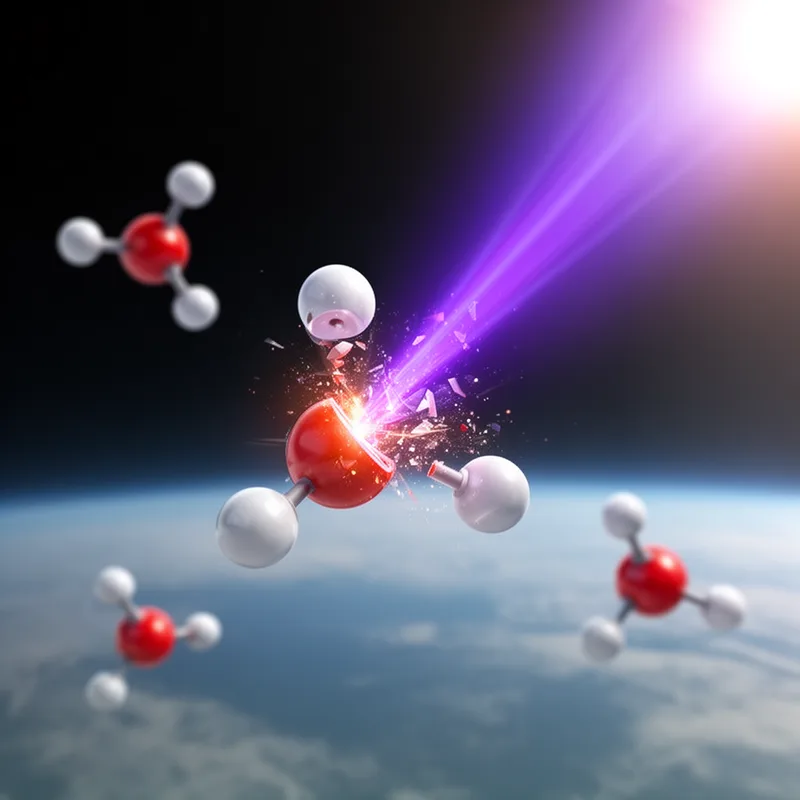
photodissociation


 1
8.9
- noun
- /ˌfoʊtoʊˌdɪsəʊsiˈeɪʃən/
- Specialized
- Understanding photodissociation is crucial for predicting how pollutants break down in the atmosphere.
Examples
-
The ensuing photodissociation produces atoms that combine with other oxygen molecules to create ozone at altitudes between 15 and 50 km.
Academic text (2006) -
Photodissociation would produce chlorine atoms, which would then catalytically destroy ozone.
Academic text (1993) -
They suggested that, once released into the environment, CFCs had lifetimes of between 40 and 150 years and had no obvious sinks other than photodissociation in the stratosphere.
Academic text (1993) -
If one is simply studying the photodissociation or isomerization of single molecules, one chooses a pump-pulse wavelength that will raise the molecule to the excited state from which it will break apart or rearrange itself.
Academic text (1999) -
The sunlight caused the photodissociation of carbon dioxide, leading to the release of oxygen.
-
During the experiment, the photodissociation of nitrogen dioxide produced reactive free radicals.
Synonyms
 1
9.1
The breakdown of a chemical by light
Surface Forms
Morphology
photodissociation = dissociation (transparent) = photo + dissociat + ion
For a learner who knows 'dissociation', adding 'photo-' straightforwardly gives the meaning 'dissociation caused by light'.
Etymology
Photodissociation comes from the prefix photo- meaning 'light' (as in photograph) and the verb dissociate meaning 'to break apart', so it describes light 'breaking apart' a chemical or molecule.