
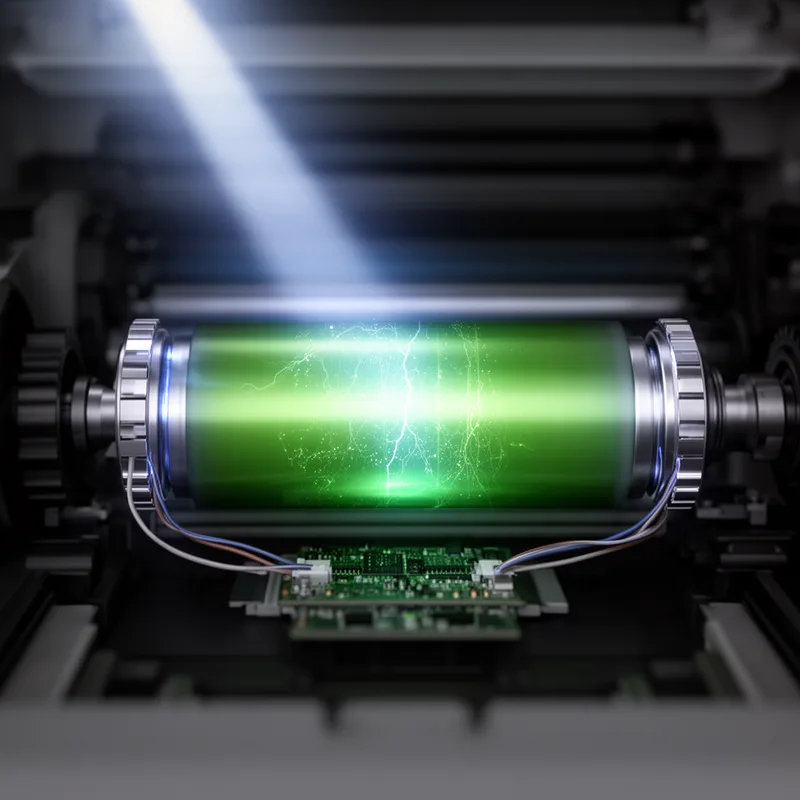
photoconductor
- noun
- /ˌfoʊtəˈkənˌdʌktər/
- Specialized
- Electrophotography creates an image by selectively discharging areas of a photoconductor drum.
- photoconductor drum
Examples
-
When exposed to light, the photoconductor generates an electric charge that forms the basis for producing printed images.
-
Electrostatic printers, also known as xerographic printers, basically use a static charge pattern on a photoconductor to attract polymeric toner particles, which are subsequently transferred to paper and heat-fused to provide the final image.
Academic text (1992) -
The field optics focus the laser beam to a small spot, called the writing spot, at the surface of the photoconductor.
Academic text (1997) -
The printhead uses a single scanning laser spot to expose the printer photoconductor.
Academic text (1997) -
Thus, the optical image, written by the printhead, becomes an electrostatic image as charge moves through the photoconductor.
Academic text (1997) -
A mirror (not shown) reflects the scanning beam to the photoconductor drum, which is located below the printhead.
Academic text (1997) -
The printhead uses a scanning-focused laser beam to write information onto a photoconductor-coated drum.
Academic text (1997) -
As the writing beam scans across the photoconductor, the power in the laser beam is modulated to form each pelt.
Academic text (1997) -
The printhead scans a modulated laser beam across the photoconductor drum, writing a raster image on a pel-by-pel basis.
Academic text (1997) -
The focused spot at the photoconductor surface for a laser printhead has a Gaussian profile because the laser beam from the gas laser, used as a light source, has a TEM 00 mode (Gaussian).
Academic text (1997)
Synonyms

 1
6.6
1
6.6

A small device that makes electricity when light hits it to show how bright the light is


 1
8.1
1
8.1
A small device that lets more electricity pass when light hits it
 1
7.2
1
7.2
A device that senses light and makes an electric signal
 1
7.4
1
7.4
A small device that changes its electric signal when light falls on it

A part in a camera or machine that detects light and makes an electric signal
A device that makes a small electric signal when light hits it to detect or measure light
Surface Forms
Morphology
Etymology
Photoconductor combines photo- ('light') and conductor ('something that carries or leads', like a metal wire or the person who leads an orchestra). So a photoconductor is a material that starts to 'carry' electricity when light shines on it.