
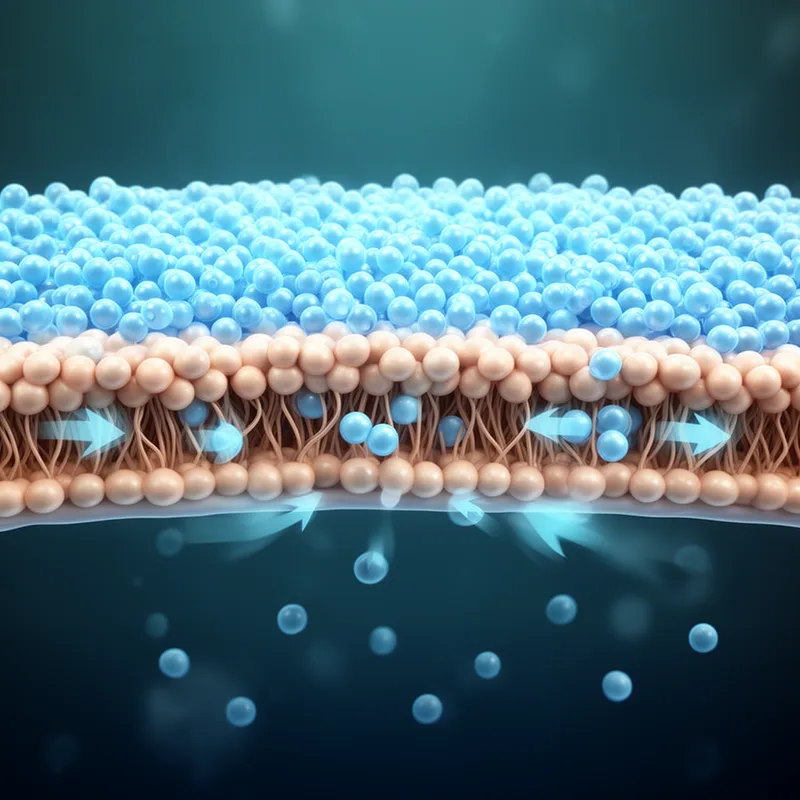
passive transport
- noun
- /ˈpæsɪv ˈtrænspɔrt/
- Specialized
- Cells utilize passive transport to move substances.
Examples
-
Many nutrients enter the bloodstream through passive transport processes.
-
The distinction between passive transport and active transport is important in biology.
-
Diffusion of oxygen into a cell is a form of passive transport.
-
Oxygen enters cells through passive transport.
-
Oxygen enters the cells through passive transport, allowing them to function without using energy.
-
Nutrients are absorbed into the bloodstream by passive transport, which requires no energy input.
-
In biological systems, passive transport occurs when molecules diffuse across cell membranes naturally.
Synonyms
 3
4.8
3
4.8

Movement of particles from a crowded area to a less crowded area
Antonyms

- Specialized
To move a substance across a cell membrane from low to high concentration using energy
How Passive
- Specialized

- Specialized
Surface Forms
Morphology
The adjective 'passive' conveys lack of active effort and 'transport' denotes movement, so a learner who knows both words can infer this refers to movement that occurs without active input (i.e. without the cell expending energy). However, the precise biological mechanism (across a membrane by diffusion) and the technical nuance may be unfamiliar, so the meaning is partially but not fully predictable from the parts.
Etymology
Passive transport uses passive (not using energy) and transport (movement): imagine perfume slowly spreading through a room on its own, 'without energy'. In cells, small molecules move across the cell membrane the same way, so passive transport means movement across a cell membrane 'without energy'.