

diffusion
 3
4.8
3
4.8

- noun
- /dɪˈfjuːʒən/
- Specialized
- The diffusion of perfume in the air allows its scent to reach every corner of the room.
- diffusion coefficient
- molecular diffusion
- diffusion rate
Loading YouTube…
Watch on YouTubeOK, so that's that's diffusion of particles of water vapor.
- OK, so that's that's diffusion of particles of water vapor.
- So since white matter like our highway system is highly directional, diffusion imaging can detect that.
- So there's just a lot of, you know, elements of these like move particles, which again, like that's governed by diffusion physics, right, movements of particles.
- They, they decrease the oxygen, you know, diffusion that's just sort of out in the air onto the surface of our eye, onto the cells that are on the surface of our eye.
- They they move at the limit of diffusion.
- There were magnetic diffusion points hit and cross like our magnetic fields hit and cross in some way.
Examples
-
The exhalation relies on the diffusion of carbon dioxide back into the atmosphere from our blood at the surface of the lungs.
-
And this is for diffusion of material from one point to another.
-
But as the size gets bigger, diffusion becomes very slow, right.
-
That's the nature of the diffusion of heat through the Turkey.
-
Most drugs cross the placenta by simple diffusion from an area of high concentration to an area of low concentration.
Academic text (2011) -
When inhaled, hydrogen sulfide readily enters the bloodstream via diffusion through pulmonary alveoli.
Academic text (2008) -
Water molecules travel through the process of diffusion, moving from areas of high concentration to low concentration.
-
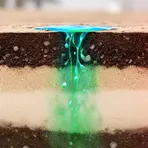
In the experiment, the diffusion of dye through water demonstrated how substances disperse in liquid.
Synonyms

 1
7.0
1
7.0
One thing slowly moves into and through another thing
Antonyms

Compounds

- Specialized
Ideas, customs, and goods like music or food spread from one group to another

- Specialized
A machine that uses a jet of vapor to remove gas and make a very strong vacuum
How Fast

Surface Forms
Morphology
Etymology
Diffusion comes from Latin parts dif- 'apart' and fundere 'to pour', so it once meant 'to pour out' or 'spread out', the same root you see in fuse. In science, imagine a crowd moving from a busy place to an empty one — molecules move from where there are many to where there are few, and that movement is called diffusion.