

passenger
 975
1.0
975
1.0

- noun
- /ˈpæsɪndʒər/
- All passengers must depart the train.
- a passenger car
- carry passengers
- a passenger ship
Loading YouTube…
Watch on YouTubeBut don't worry, the passengers are like having a little holiday.
- But don't worry, the passengers are like having a little holiday.
- You can't trust cruise passengers to make smart health decisions.
- The first one press it and the passenger door closes as well.
- Delta in response to that, banned, not the passenger that said that, but the pins.
- The sole driver and passenger of the Tesla passed away, died.
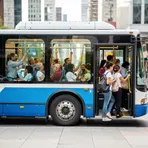
- I thought those were ghost buses ferrying spectral passengers across the River Styx.
- I opened my briefcase on the passenger seat just so they could see.
Examples
-
Attention, all passengers!
-
In the United States and many other countries, passengers are carried by numerous independent airlines.
Academic text (1990) -
I think some of your passengers may need your help.
-
Not a trace of the plane or its passengers has ever been found.
-
Suddenly the pilot and the passengers felt this jolt.
-
Space flights will last approximately 2.5 hours, carry six passengers, and reach a speed of Mach 3.
Academic text (2008) -
Named after Jonathan Swift, the ferry is designed to carry 800 passengers and 200 cars.
Academic text (2008) -
The Immigration Hall is filled with passengers arriving from Earth, queued up in three long lines.
Fiction book (1990) -
Among the passengers was celebrated screen actress Carole Lombard.
-
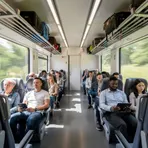
The train was crowded, and every passenger had to find their seat quickly.
Synonyms


Antonyms

Compounds



 1
9.5
1
9.5
A large North American pigeon that lived in huge flocks but is now extinct
How Often


Surface Forms
Morphology
Etymology
Passenger comes from the simple verb pass, which means 'to go by' or 'move past'. So a passenger is someone who 'goes along' in a car, train, or plane rather than the person who is driving.