
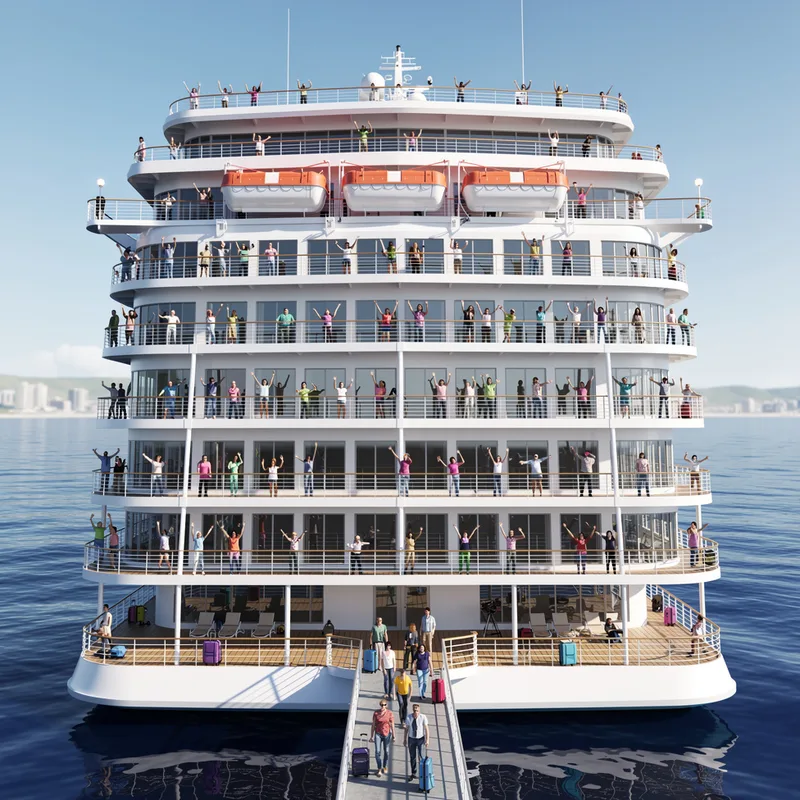
passenger ship
 3
2.2
3
2.2

- noun
- /ˈpæsɪndʒər ʃɪp/
- Two common types of passenger ships are ferries and cruise ships.
- cargo and passenger ships
- larger passenger ships
- world's largest passenger ship
Loading YouTube…
Watch on YouTubeMerchant ships and passenger ships were unfortunately far, far easier to bring down.
- Merchant ships and passenger ships were unfortunately far, far easier to bring down.
Examples
-
The City of Birmingham, a passenger ship built for the Ocean Steamship Company of Savannah, was first launched in August 1923.
Academic text (2010) -
There were steam freighters, lumber schooners, coastwise passenger ships, as well as fishing boats and other smaller vessels.
Fiction book (1992) -
If we have the opportunity, we'll board the passenger ship.
Fiction book (1993) -
Should I book a seat on that new space passenger ship that is in the news, or can I wait?
Blog text (13) -
The passengers from the passenger ship said that he only had one shoe on.
-
On a passenger ship, life-support systems have primary priority.
Fiction book (1999) -
It's a passenger ship.
Fiction book (2002) -
From the 1880s to the early 1940s, passenger ships ran between Manhattan and Atlantic Highlands four or five times a day in summer.
Academic text (1990) -
In 1963, he boarded a passenger ship for America, landing in New York.
-
Two common types of passenger ships are ferries and cruise ships.
Synonyms
 ∞
1.0
∞
1.0
A large boat that carries people or goods across the sea
 137
1.3
137
1.3
A boat or ship that carries people, cars, and goods across water on a regular schedule
 50
2.6
50
2.6
A large ship that carries people on holiday trips with places to sleep and entertainment
 24
3.2
24
3.2
A large passenger ship that sails on regular long routes
 6
3.6
6
3.6
A large ship that carries people and things on long sea trips
 4
3.2
4
3.2
A large passenger ship for holiday trips with food, pools, and shows on board
 3
4.0
3
4.0
A large ship with very comfortable rooms and extra services for passengers
 3
2.6
3
2.6
A boat that carries people and cars across water on a regular route
 3
5.1
3
5.1
A ship that carries goods or passengers for business and is not part of a navy

 1
7.5
1
7.5
A very large passenger train car with two levels for carrying people

A passenger ship with private cabins for travelers
How Big

Surface Forms
Morphology
The meaning is directly and compositionally built from 'passenger' (a person traveling) + 'ship' (a vessel), yielding a vessel that carries people rather than cargo. This is a regular noun–noun compound pattern common across languages and standard in English, so a B1 learner who knows both constituents will readily infer the meaning.
Etymology
The name passenger ship started as a simple description: passenger means 'people who travel' and ship means 'a large boat'. Together they create the clear image of a boat 'to carry people', so the phrase now means 'a large ship built to carry people rather than cargo'.