
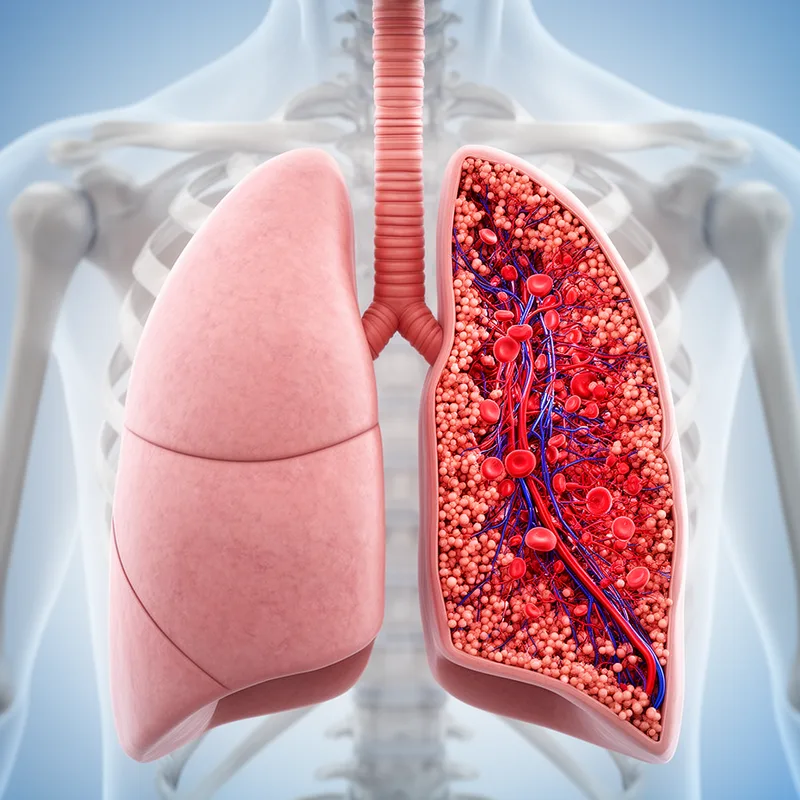
parenchymal
 1
9.9

- adjective
- /pəˈrɛŋkɪməl/
- Specialized
- Under the microscope, we observed the parenchymal cells that perform the organ's essential functions.
- parenchymal abnormalities
- parenchymal disease
- parenchymal neurocysticercosis
Examples
-
Foreign bodies in the lung warrant careful surgical removal to prevent any pulmonary parenchymal complications.
Academic text (2007) -
Parenchymal neurocysticercosis affects the cerebral hemispheres, presenting various stages of the NCC.
Academic text (2016) -
No evidence of parenchymal disease was seen.
Academic text (2008) -
No patient had parenchymal disease or obstruction.
Academic text (2000) -
Pulmonary parenchymal foreign bodies are mostly introduced as a result of trauma.
Academic text (2007) -
Also, when antiprotease defense is decreased, lung parenchymal changes may result.
Academic text (2007) -
Finally, patients with cirrhosis can also develop renal failure due to parenchymal renal diseases, particularly glomerulonephritis.
Academic text (2003) -
Typical classification of neurocysticercosis is parenchymal, intraventricular, subarachnoid, and spinal neurocysticercosis based on parasite/lesion location 5,7.
Academic text (2016) -
Enhanced CT can present multiple, larger live cysts with eccentric scolex, parenchymal lesions, and ring-like lesions.
Academic text (2016) -
Microscopic observation of inflamed tissues offers a stunning choreography of neutrophils rapidly migrating from vessels into the parenchymal spaces.
Academic text (2016)
Synonyms

 1
9.9
The main tissue in an organ or plant that does most of the work
Surface Forms
Morphology
parenchymal = parenchyma (semi-transparent) = parenchyma + al
The adjective is formed regularly from the technical noun 'parenchyma', but the specialized medical meaning is not fully guessable for an average learner.
Etymology
Parenchymal comes from the Greek parenchyma, built from para- 'beside' (the same para- as in parallel) and a root meaning 'to pour in', and it was used for the soft, filled-in inner parts of plants and animals. So parenchymal means the working, inner tissue of an organ, not the supporting tissue that holds it together.